A heavy truck frame rail is not a component that can be treated as a standard weldment. Its length, section geometry, hole pattern, material condition, and downstream assembly interfaces all affect vehicle manufacturing. For OEMs evaluating heavy steel fabrication Mexico suppliers, the practical question is whether the fabricator can control those variables consistently from the first production part through scheduled releases.
That evaluation should go beyond a general equipment list. Heavy fabrication programs require enough forming force and bed length for the part, cutting capacity that supports nesting and repeatable feature location, qualified welding control, dimensional verification, and production systems that maintain traceability as volumes increase. The right supplier fit depends on the product family, annual demand, material thickness, weld requirements, and the consequences of variation at the next assembly stage.
What heavy steel fabrication in Mexico must deliver
For heavy OEM components, manufacturing capability is meaningful only when it is connected to the geometry and production requirements of the part. A supplier may have substantial welding capacity, for example, but that does not by itself confirm it can form a long rail without unnecessary setups, hold critical locations across a large subassembly, or document inspection results in the manner a customer requires.
Heavy truck frame rails illustrate the point. These parts often combine long formed sections, laser-cut holes and slots, carefully controlled bends, and interfaces that must align with crossmembers, brackets, suspension components, and other assemblies. A process that introduces variation early in cutting or forming can create fit-up problems later, even when the final weld appearance is acceptable.
The same principle applies to transformer tanks, large freight rail components, and data center structures. Each category has different priorities. Transformer tanks may place greater emphasis on weld integrity, plate preparation, and controlled assembly. Rail components may require documented quality systems and repeatable dimensional control. Data center structural assemblies can demand accurate fabrication of large members while accommodating project-specific configurations.
A capable fabrication review begins by matching the drawing package to the manufacturing route. That means identifying material grade and thickness, formed lengths, internal radii, hole-to-bend relationships, weld symbols, critical-to-function dimensions, component weight, inspection requirements, and expected release quantities. It also means raising questions before production rather than treating manufacturability issues as shop-floor corrections.
Forming capacity for long, heavy components
Press brake capacity is a central consideration for chassis rails and other long formed steel parts. Tonnage alone is incomplete. Buyers should consider the available forming length, tooling approach, material properties, bend geometry, part handling, and the number of setups required to produce the finished profile.
IONSA operates a 2,400-ton CNC press brake with a 53-foot forming length. This combination is relevant when a program includes long chassis rails or large structural components that benefit from being formed on equipment sized for their overall length. Fewer interruptions in the forming process can help preserve consistent geometry and reduce the need to divide a component into smaller sections solely to fit available equipment.
Forming feasibility still depends on the specific drawing. Material thickness and grade affect required tonnage, while bend radius, flange dimensions, and hole placement can affect tool selection and sequence. For procurement teams, the useful question is not whether a press brake is large. It is whether the supplier has reviewed the actual formed profile and can explain how the part will be supported, bent, checked, and moved through production.
Laser cutting and feature location
Long parts need more than sufficient forming capacity. Their holes, slots, edge conditions, and cut profiles must be produced from a stable reference strategy. Laser cutting can support accurate feature placement before forming and welding, particularly when parts include repeated patterns or multiple interfaces along a long length.
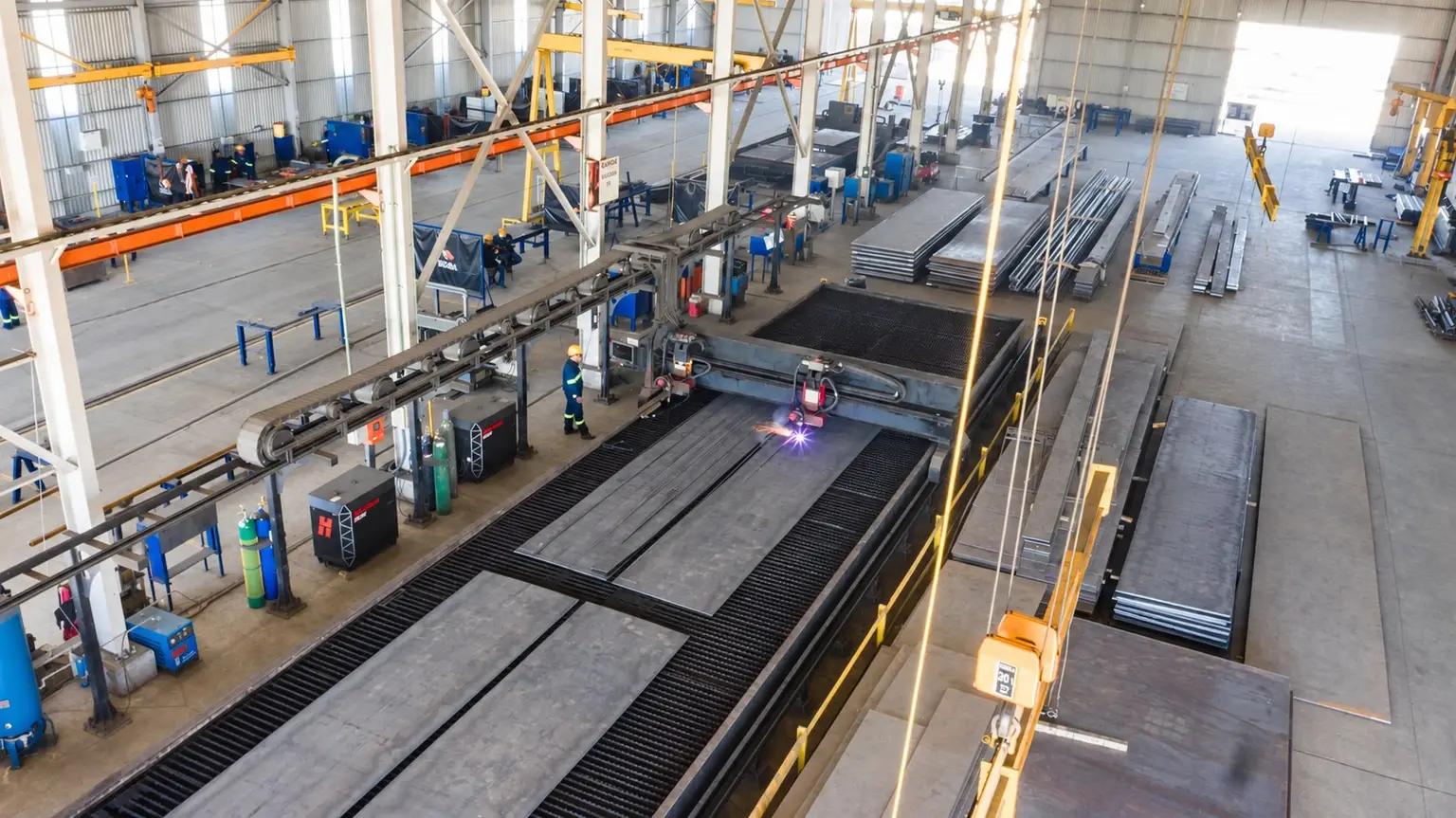
A 30 kW fiber laser with a 16-meter cutting bed provides the working envelope needed for long plates and structural blanks. For heavy truck rails, large rail structures, and fabricated steel assemblies, that bed length can reduce the need to section a blank before cutting. It also allows cutting operations to be planned around the full part geometry rather than around a smaller machine envelope.
Laser power is only one factor in cut quality. Material type, thickness, edge requirements, part nesting, heat input, and downstream welding all influence the appropriate cutting plan. A supplier should be prepared to review whether cut features will serve as assembly datums, whether edge preparation is needed before welding, and how parts will be identified as they move from cutting to forming and assembly.
Welding quality must be built into production
Heavy subassemblies frequently involve multiple welds, fixtures, and handling steps. The manufacturing challenge is not simply depositing weld metal. It is producing assemblies that meet the drawing requirements while controlling distortion, access, sequence, and inspection.
More than 150 welding stations provide production capacity for programs that require parallel work cells or multiple assembly stages. However, the relevant sourcing discussion should also cover welding procedures, joint access, fixture strategy, fit-up control, inspection points, and how nonconforming conditions are contained and addressed.
An in-house AWS Certified Welding Inspector adds direct technical oversight to the quality process. For OEM quality teams, access to welding inspection capability can support clearer communication around weld acceptance criteria, visual inspection, documentation expectations, and corrective action when an issue is found. The required level of inspection will vary by application, material, and customer specification, so it should be defined during qualification rather than assumed.
AAR M-1003 certification is also relevant for customers sourcing freight rail components or evaluating a supplier’s quality system for demanding fabricated products. Certification does not replace a program-specific quality plan, but it can be an important part of supplier qualification where rail industry requirements apply.
Dimensional control across large assemblies
Large fabricated parts can meet individual cut and formed dimensions yet still miss the overall assembly requirements. Weld sequence, clamping, heat input, component variation, and handling can all affect final geometry. This is why dimensional inspection should be planned around functional interfaces, not only around isolated dimensions.
Creaform dimensional inspection equipment supports measurement of complex and large fabricated components. For a heavy subassembly, the inspection plan may focus on mounting locations, rail spacing, hole positions, critical surfaces, flatness requirements, or the relationship between welded features. The appropriate method and reporting format depend on the drawing and customer requirements.
Purchasing and engineering teams should clarify which dimensions are critical to function, what datum scheme applies after fabrication, and whether first article, in-process, or final inspection documentation is required. Those decisions influence fixture design, process controls, and the amount of inspection needed at each production stage.
Traceability and production visibility
As programs move from prototype quantities to recurring production, material and process visibility become increasingly important. A practical production system should help a supplier track work orders, material movement, manufacturing status, and inspection activity without relying on disconnected spreadsheets or informal handoffs.
MIETrak ERP supports production planning and traceability across fabrication operations. For OEM customers, the value is operational: clearer coordination of material, routing, work in process, and scheduled releases. The specific documentation package should be aligned with the purchase order, customer quality requirements, and component risk.
Traceability needs differ by program. A heavy truck rail program may emphasize repeatable release management and part identification. A transformer tank program may require closer attention to material documentation and welding records. Large data center structures may prioritize schedule coordination, configuration control, and shipping readiness. The supplier’s system should be able to support the applicable requirement without adding unnecessary administrative steps.
Qualifying a supplier before production
A productive supplier review is based on the real manufacturing inputs. Provide current drawings, revision status, annual and release quantities, material specifications, component weights, critical dimensions, weld requirements, inspection expectations, packaging needs, and delivery schedule. If the part has known fit-up challenges or prior quality concerns, identify them early.
The fabricator can then assess whether the laser bed, press brake, welding stations, inspection equipment, and production controls fit the program. That engineering-informed review is more useful than a generic capacity statement because it identifies process considerations before tooling, material purchasing, and production scheduling are committed.
For OEM teams sourcing from the United States or Mexico, Monclova, Coahuila offers a manufacturing location with direct relevance to cross-border industrial supply. The final decision, however, should rest on program fit: the supplier’s ability to manufacture the actual part, document the required controls, and support repeatable releases as the program develops.
Submit drawings, quantities, dimensions, component weights, production schedules, and project requirements for a manufacturing review. A clear review at the beginning gives engineering, quality, and purchasing teams a better basis for building a stable fabrication program.
Discuss your production requirements
Explore IONSA’s Heavy steel fabrication. Request a quote and upload your drawing with the current revision, material, quantities, overall dimensions, component weight, delivery schedule, and required inspection records. IONSA will review drawing-specific feasibility before confirming tolerances, capacity, or lead time.