A large rail assembly can be fully welded and still fail supplier acceptance because a formed section does not hold its profile, a critical interface shifts during welding, or inspection records cannot be tied back to the production lot. For OEMs and rail-equipment suppliers, selecting a freight rail component manufacturer is therefore a manufacturing qualification decision, not simply a price comparison.
The right supplier must be able to translate drawings into a controlled sequence of cutting, forming, fit-up, welding, inspection, and documentation. That sequence matters especially for long, heavy steel components, where part handling, heat input, and datum control affect final dimensions as much as the original machining or laser-cutting operation.
What a freight rail component manufacturer must control
Freight rail components range from fabricated brackets and housings to long structural assemblies, underframe elements, and other heavy welded steel parts. Their requirements vary by application, but buyers generally need the same fundamentals: consistent material identification, repeatable geometry, qualified welding controls, and inspection evidence that supports acceptance.
A supplier review should begin with the component itself. Part length, plate thickness, formed features, component weight, weld access, critical interfaces, and annual volume all influence the manufacturing route. A short, thick welded assembly may be governed by machining access and fixturing. A long fabricated rail structure may be governed by laser-bed capacity, press brake length, material movement, and weld sequence.
These differences are why equipment lists alone are not enough. The relevant question is whether the supplier can apply its equipment in a process that preserves the dimensions and functional features identified on the drawing.
Forming capacity for long structural components
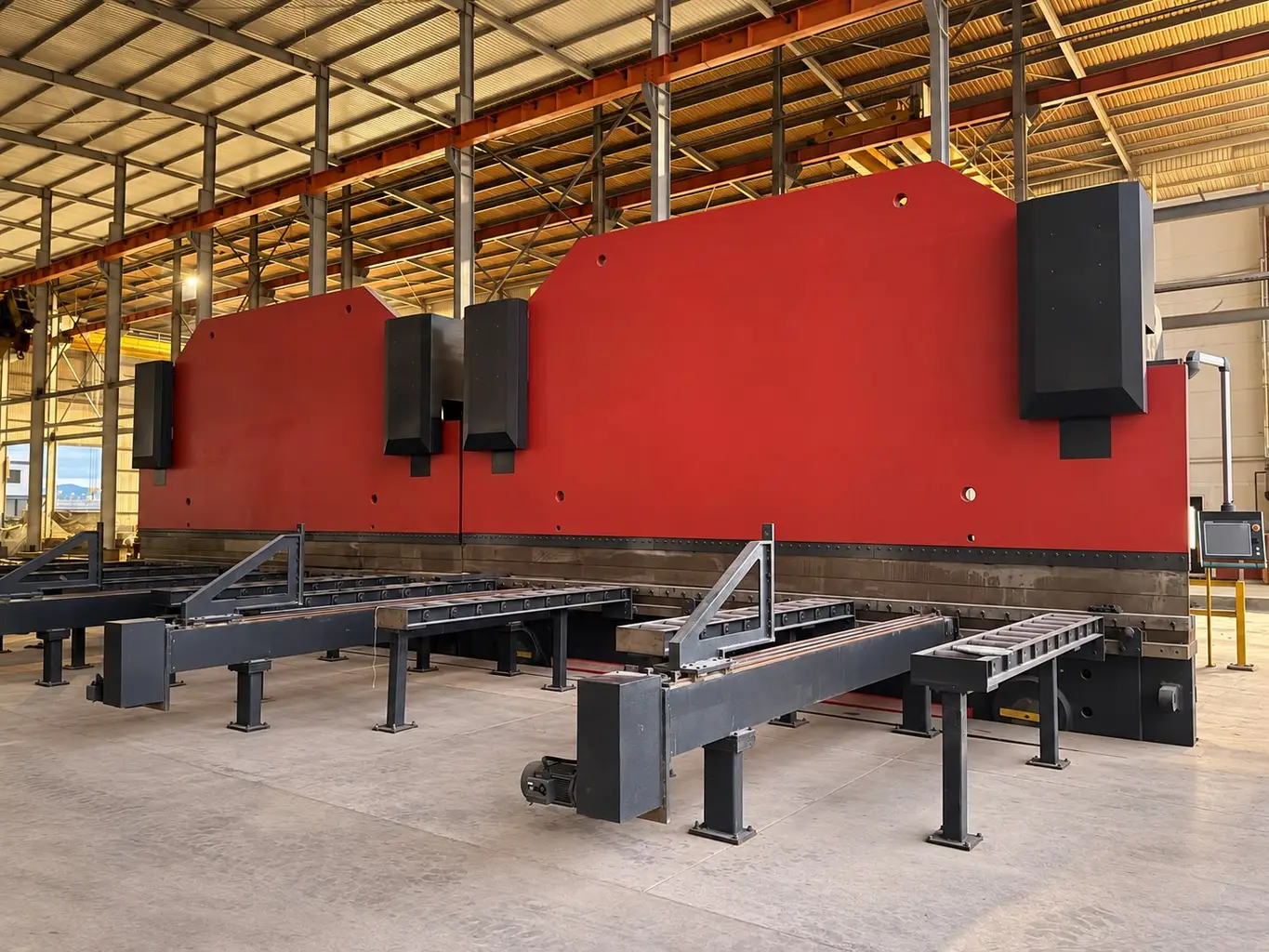
Long formed sections require more than sufficient tonnage. The press brake must also provide the bed length needed to form the component without unnecessary repositioning or segmented operations. Each additional setup can add opportunities for variation, particularly when a part includes long flanges, channels, or structural bends that establish downstream weld and mounting interfaces.
For large rail structures and comparable heavy fabrications, a 2,400-ton CNC press brake with a 53-foot forming length can support substantial formed components in a single machine setup when the part geometry and tooling plan allow it. Buyers should confirm the required bend length, material grade and thickness, bend radii, flange orientation, and any flatness or straightness requirements before assigning a forming process.
It also depends on the design. Some parts are better produced as welded built-ups rather than one long formed section. A capable manufacturer should be able to review that trade-off early, considering not only piece cost but also distortion risk, weld access, inspection requirements, and the effect on repeatability.
Cutting capacity affects material use and part flow
The first operation often determines how efficiently a large component moves through the rest of the plant. Accurate blank development and stable cut quality support more consistent forming and fit-up. They can also reduce the rework associated with gaps, misaligned tabs, or inconsistent prepared edges.
A 30 kW fiber laser with a 16-meter cutting bed gives a manufacturer the capacity to process long plate components used in rail structures, chassis rails, and other large steel fabrications. For a sourcing team, the practical benefit is not simply laser power. It is the ability to keep long parts within a controlled cutting process rather than dividing them into smaller sections solely to fit a shorter machine bed.
During qualification, ask how nests are managed, how cut parts are identified after separation, and how the supplier preserves traceability through downstream operations. These process details become more important as component size, part count, and production volume increase.
Welding quality is a system, not a final check
Rail assemblies frequently combine heavy plate, formed members, stiffeners, brackets, and machined interfaces. Welding joins these elements, but it can also introduce distortion that affects mounting locations and overall geometry. The manufacturer needs a defined approach to fixture design, weld sequencing, interpass control where required, and verification after welding.
An in-house AWS Certified Welding Inspector adds direct technical oversight to welding inspection activities. More broadly, buyers should evaluate whether welding is supported by documented procedures, appropriate operator qualification, clear inspection points, and a practical response when a nonconformance is found.
Production scale matters here. A facility with 150+ welding stations can support multiple assemblies and program stages, but capacity should be reviewed against the actual workload, welding process, fixture availability, and delivery schedule. A high station count does not automatically mean a part can be produced correctly or immediately. The relevant measure is whether the supplier can allocate the right process, people, and inspection resources to the program.
For rail work, AAR M-1003 certification is also a meaningful qualification consideration. It indicates that the supplier operates within a quality framework recognized for the rail industry. Purchasing and quality teams should still align on the exact documentation, inspection records, material requirements, and customer-specific provisions required for the component at hand.
Dimensional inspection must match the part’s function
A drawing may contain dozens of dimensions, but not all dimensions carry the same functional risk. Critical features typically include mounting hole patterns, interface planes, formed profiles, overall length, centerline relationships, and welded attachment locations. These should be identified before production so the inspection plan concentrates on features that affect assembly and service performance.
For large or complex parts, portable dimensional inspection can provide useful verification without forcing the workpiece onto a conventional measurement table. Creaform dimensional inspection equipment can support the evaluation of formed and welded geometry, particularly where multiple interfaces must be checked against the component’s datums.
The inspection method should be agreed upon before the first production run. Buyers should clarify whether they need first-article inspection, in-process dimensional checks, final inspection reports, serialized records, or sampling plans for repeat production. They should also specify the drawing revision, datum scheme, measurement units, and any reporting format expected by their quality system.
This is where program teams can prevent avoidable disputes. A supplier may inspect a feature accurately but reference it from a different datum interpretation than the customer expects. Resolving the inspection approach before fabrication is faster and less costly than debating a completed assembly.
Traceability connects material, process, and shipment
When a component is heavy, complex, or produced for a controlled rail application, traceability cannot be treated as a paperwork exercise. Material heat information, receiving status, work order identification, revision control, inspection status, and shipment records need to remain connected throughout the production route.
An ERP system such as MIETrak can provide the operational structure for managing work orders, production status, and records across manufacturing steps. The value for a buyer is visibility and accountability: the ability to establish what was built, to which revision, from which controlled materials, and under what inspection status.
The required depth of traceability depends on the application. A repeat production bracket may need a different documentation package than a major structural assembly with specified material certifications and formal inspection hold points. The supplier should not assume the requirement, and the customer should not leave it implied in a purchase order.
Build supplier qualification around the actual program
The most useful supplier review is based on real program inputs rather than a generic capability questionnaire. Provide current drawings, expected quantities, dimensions, component weight, material specifications, required weld standards, inspection requirements, and delivery schedule. If the part will be released in phases, include prototype, pilot, and production expectations.
Ask the manufacturer to identify the expected manufacturing route and any items requiring clarification. This discussion can expose practical issues early, such as whether a long bend needs special tooling, whether a welded assembly needs dedicated fixturing, whether a machined feature should be completed before or after welding, or whether the inspection plan needs additional datums.
For OEMs in the United States and Mexico, a manufacturing partner in Monclova, Coahuila can be positioned to support cross-border supply programs when engineering communication, production planning, and shipping requirements are clearly defined. IONSA can review drawings and program requirements against its heavy fabrication, machining, forming, laser cutting, welding, and inspection capabilities.
Send the drawing package, quantities, component dimensions, weight, required documentation, and target delivery schedule for an engineering-informed manufacturing review. A clear production plan at the sourcing stage gives both teams a better basis for building repeatable rail components.
Confirm the rail quality scope
IONSA holds AAR M-1003 quality assurance certification. Buyers should confirm the current certificate’s facility and activity scope against their rail program; it does not replace drawing-specific or customer acceptance requirements. Long and heavy rail components also require an agreed lifting, fixturing, dimensional inspection, and delivery plan. Component weight and handling requirements must be reviewed for each project.
Discuss your production requirements
Explore IONSA’s Large rail components. Request a quote and upload your drawing with the current revision, material, quantities, overall dimensions, component weight, delivery schedule, and required inspection records. IONSA will review drawing-specific feasibility before confirming tolerances, capacity, or lead time.