A construction equipment frame manufacturer is not simply a source for cut and welded steel. The supplier’s fabrication quality affects the load-carrying structure, assembly sequence, and quality system behind equipment that operates under vibration, impact, shifting loads, and demanding service conditions. For OEM purchasing and engineering teams, the central question is whether a fabricator can repeatedly produce large, weld-intensive structures that match released drawings and integrate predictably with downstream machining, painting, and final assembly.
That evaluation requires more than a review of shop size or a quote comparison. Frame sections, crossmembers, equipment bases, brackets, and welded subassemblies introduce interdependent requirements for material handling, long-part forming, weld access, dimensional inspection, traceability, and production scheduling. The right manufacturing approach depends on component geometry, annual volume, material grade, weld requirements, and the consequences of variation at final assembly.
What a construction equipment frame manufacturer must control
Construction equipment frames are often fabricated from thick plate, structural sections, or formed components that must retain their geometry through multiple operations. A part may begin as a long laser-cut blank, move through high-tonnage bending, receive welded attachments and reinforcements, and then require inspection before shipment. Variation introduced at any point can compound through the process.
Flatness, hole location, flange angle, and weld distortion are not isolated drawing details. They affect whether pins, powertrain mounts, hydraulic supports, guarding, cabs, and auxiliary systems fit as intended. A supplier should be able to explain how it manages the relationship between cutting, forming, fixturing, welding sequence, and inspection rather than treating each operation as a separate transaction.
For large fabricated structures, capacity also has practical limits. A fabricator may have suitable welding expertise but lack the bed length to process a long blank efficiently. Another may form short components well but be unable to bend long rails without splices or multiple setups. These limitations are not automatically disqualifying, but they should be visible early in the sourcing process because they influence cost, consistency, handling risk, and manufacturability.
Match equipment capacity to frame geometry
The most useful capability review starts with the part, not the supplier brochure. Review overall length, width, thickness, material grade, component weight, formed profiles, weld access, and critical interfaces. Then compare those requirements with the supplier’s actual processing envelope.
Long structural members benefit from equipment sized for long blanks. IONSA operates a 30 kW fiber laser with a 16-meter cutting bed and a 2,400-ton CNC press brake with 53 feet of forming length. For heavy truck frame rails and comparable long fabricated components, this combination can reduce the need to divide a long profile into smaller sections solely to fit the equipment. Fewer part splits can mean fewer joints, fewer handling steps, and a simpler dimensional control plan.
That does not mean every frame should be designed as one long formed part. Segmented fabrication can be appropriate where transportation limits, serviceability, material availability, or assembly architecture support it. The engineering review should establish whether segmentation is intentional and functional, rather than a workaround for a supplier’s equipment limitations.
Cutting capability also matters beyond overall length. Clean, accurate blanks support repeatable forming and fixture location. When holes, slots, and profiles are incorporated upstream, the team should confirm datum strategy and understand which features will be used to establish position during later operations. A nominally accurate cut part can still create assembly problems if the datum scheme is inconsistent between cutting, bending, and welding.
Welding quality is a process, not a final check
Frame assemblies frequently include welds at highly loaded intersections, mounting interfaces, reinforcement plates, and structural joints. The appropriate weld requirements depend on the application, material thickness, joint configuration, and design criteria. The manufacturer should review drawing callouts, applicable welding codes, inspection requirements, and any customer-specific procedures before production begins.
Production scale affects welding consistency. More than 150 welding stations give IONSA the capacity to support parallel work across heavy steel assemblies, but station count alone is not a quality plan. Repeatability comes from qualified procedures, suitable fixtures, controlled weld sequences, trained personnel, and inspection at meaningful points in the route.
An in-house AWS Certified Welding Inspector provides direct technical support for weld quality verification. For OEM teams, this can be particularly valuable when a program involves first-article review, revised weld details, visual acceptance requirements, or recurring quality documentation. The objective is not to inspect quality into a part after all welding is complete. The objective is to control the process so issues are identified before they affect subsequent operations or shipment.
Weld distortion deserves specific attention during design and sourcing reviews. Heat input can pull flanges, alter rail straightness, and shift attachment locations. Heavy fixtures, balanced welding sequences, intermittent weld design where permitted, and planned inspection points can help manage these effects. The correct method varies by part. A frame with thick, symmetrical members behaves differently from a thin-gauge enclosure or an asymmetrical welded bracket assembly.
Dimensional inspection should reflect assembly risk
A dimensional report is useful only when it measures features that matter to function. For a construction frame, those features may include mounting-hole patterns, pin bores, rail spacing, critical face locations, diagonal relationships, and attachment planes. The inspection plan should identify datums that reflect how the frame is located in final assembly.
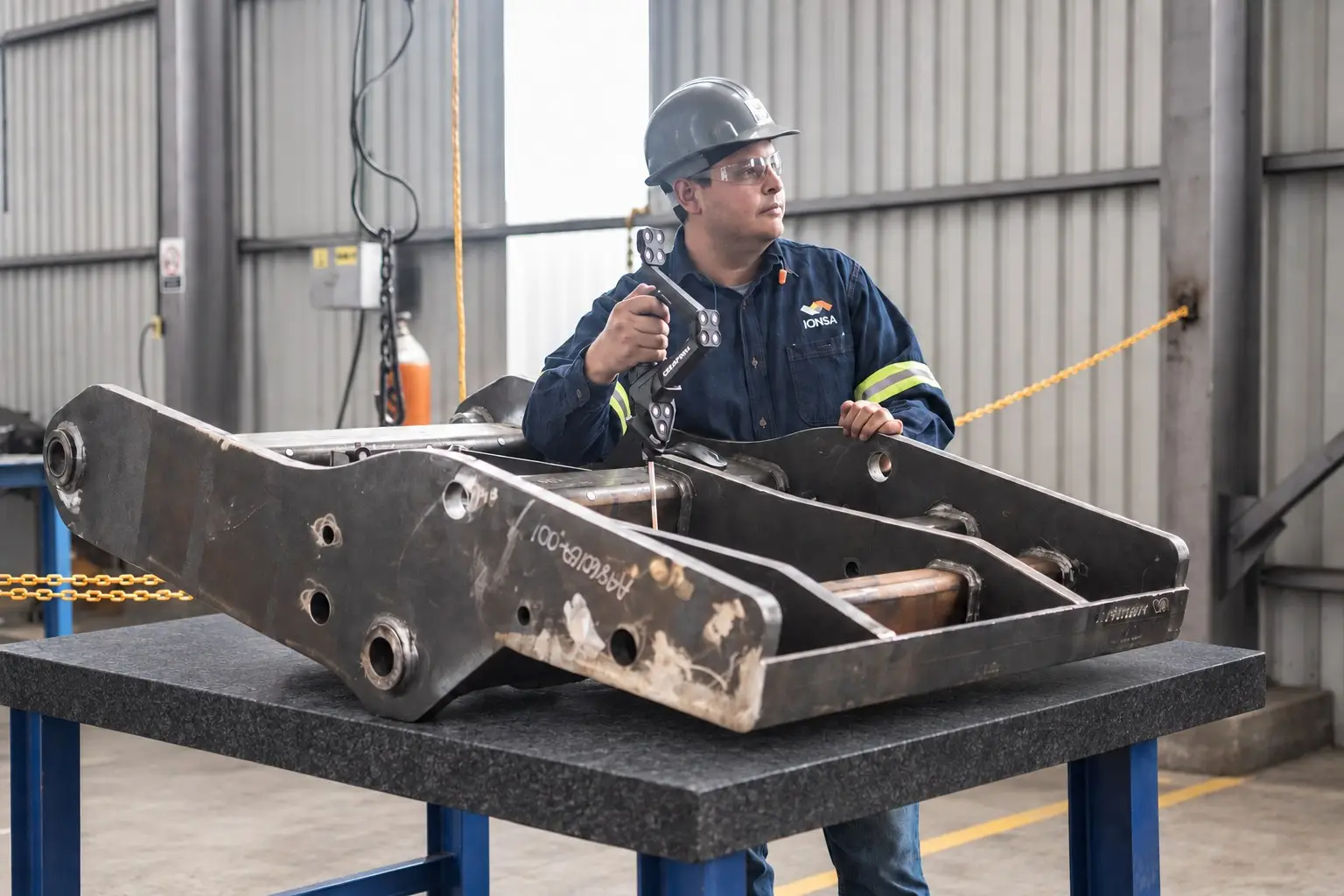
Creaform dimensional inspection equipment supports comparison of fabricated parts against CAD geometry and defined inspection requirements. This is particularly relevant for large or complex weldments where traditional point-to-point measurement alone may not reveal accumulated variation across the structure. The appropriate level of inspection depends on program risk, production maturity, and the customer’s quality plan.
First articles generally merit more extensive verification than established production parts. After process capability is understood, a practical control plan may focus on the features most likely to affect fit and function. Conversely, an engineering change, new fixture, material substitution, or revised welding sequence may justify expanded validation. The key is that inspection frequency and coverage should be based on risk, not convenience.
Traceability and production control matter after award
Supplier qualification does not end when the first parts pass inspection. Purchasing and program teams need confidence that the approved process can be repeated as volumes change, schedules tighten, and engineering revisions are released. Material identification, revision control, routing discipline, inspection records, and nonconformance handling all contribute to that confidence.
MIETrak ERP supports production planning and traceability across the manufacturing workflow. For a fabricated frame program, production control should make it possible to connect a shipped assembly to its material, routing, work status, and applicable drawing revision. The exact records required will vary by OEM and end use, but the system should support the customer’s documentation needs before launch rather than being adapted after a quality issue.
AAR M-1003 certification is also relevant for organizations evaluating suppliers that serve demanding rail-related manufacturing environments. While certification requirements must always be matched to the specific program, an established quality framework can indicate the level of process discipline available for large fabricated steel components.
What to provide for an effective manufacturing review
A useful request for quotation gives the fabricator enough information to evaluate manufacturing feasibility, not just material weight and unit quantity. Providing the correct technical package early helps identify concerns before they become quoted assumptions or launch delays.
For heavy frames and subassemblies, include the following information when available:
- Current drawings and 3D models, including revision status and critical dimensions.
- Annual volumes, release quantities, prototype needs, and required delivery schedule.
- Material specifications, thickness ranges, coating requirements, and weld standards.
- Overall dimensions, component weight, inspection requirements, and packaging constraints.
- Known assembly interfaces, critical-to-function features, and requested quality documentation.
This information allows a manufacturer to assess whether the work should be processed as a formed rail, a welded subassembly, a plate-and-structure assembly, or a combination of methods. It also gives engineering and sourcing teams a better basis for comparing quotations. The lowest unit price may reflect a different fixture strategy, inspection scope, weld approach, or handling assumption than the alternatives.
For OEMs sourcing in the United States and Mexico, manufacturing location can also influence freight planning, communication cadence, and supply-chain design. IONSA’s operation in Monclova, Coahuila, supports cross-border programs while providing heavy fabrication and machining resources for large steel components.
The most productive next step is a drawing-based review. Submit the component drawings, quantities, dimensions, weights, production schedule, and quality requirements so the manufacturing approach can be evaluated against the actual frame design rather than a generic capability list.
Discuss your production requirements
Explore IONSA’s Heavy steel fabrication. Request a quote and upload your drawing with the current revision, material, quantities, overall dimensions, component weight, delivery schedule, and required inspection records. IONSA will review drawing-specific feasibility before confirming tolerances, capacity, or lead time.