
Data center steel structure fabrication is often treated as a straightforward steel-buying exercise until the first large assembly reaches the site. At that point, small dimensional variation, incomplete weld documentation, unplanned splices, or handling damage can affect equipment installation, field labor, and project schedules. For OEMs and project teams, the fabrication scope needs to be defined as a controlled manufacturing process, not simply a collection of cut and welded members.
Data center projects can require fabricated steel for equipment support frames, structural skids, enclosure components, platforms, access assemblies, and other large-format structures. The specific design varies by application, but the sourcing priorities remain consistent: repeatable dimensions, qualified welding, material control, practical lifting features, and a supplier that can manufacture to the release schedule.
Data center steel structure fabrication starts with the build strategy
A complete drawing package is necessary, but it does not always answer every manufacturing question. Fabricators need to review material grades, member lengths, plate thicknesses, weld symbols, critical interfaces, allowable flatness or straightness requirements, coating requirements, and the intended shipping configuration. These details determine whether a structure should be made as one assembly, divided into shippable modules, or designed with bolted field connections.
The best approach depends on the finished component’s dimensions, weight, installation sequence, and transportation limits. A larger shop-welded assembly can reduce field welding and simplify fit-up at the site. However, it may create more demanding lifting and freight requirements. A modular design can make shipping and handling easier, but adds interfaces that must be accurately located and clearly marked.
Early manufacturing review is particularly useful when designs include long formed members, heavy plate, close equipment interfaces, or repeated assemblies across multiple sites. It gives engineering, quality, and sourcing teams a chance to identify manufacturability concerns before material is released to production.
Forming and cutting capacity affect design options
Heavy structural fabrication is governed by more than nominal steel thickness. Plate size, part length, bend geometry, material condition, and handling method all affect whether a component can be produced consistently. When a design includes long channels, stiffened panels, formed rails, or large base elements, equipment capacity becomes a practical qualification point.
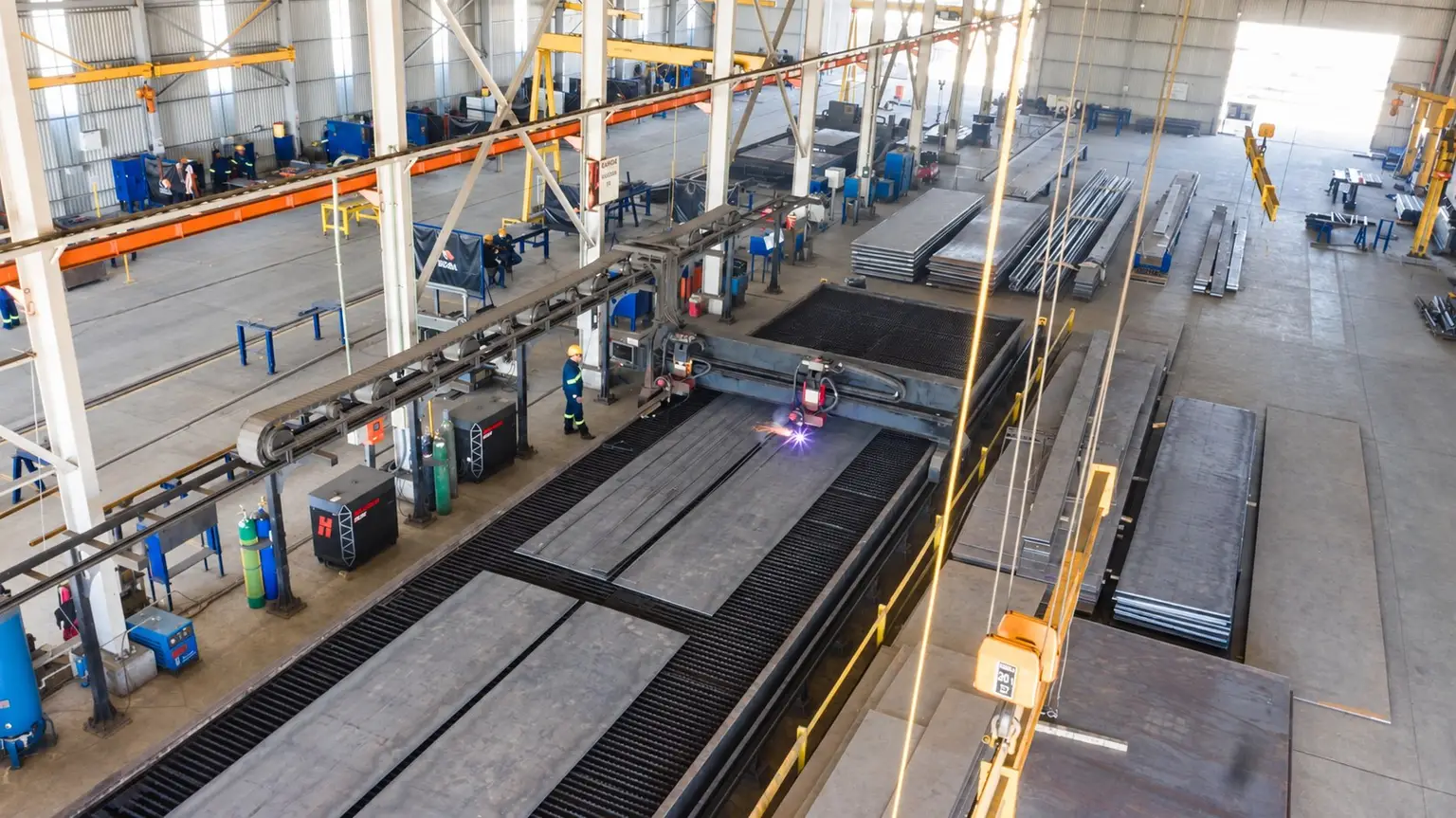
IONSA operates a 2,400-ton CNC press brake with a 53-foot forming length. This capacity can support long formed parts while reducing the need to create a member from multiple shorter sections. Fewer splices may simplify downstream assembly and reduce the number of weld locations that require inspection, although a splice may still be the correct engineering choice for transport, access, or installation reasons.
The company’s 30 kW fiber laser with a 16-meter cutting bed also supports processing of long plate and structural components. Long-bed cutting can reduce part segmentation and help maintain common datums across components cut from the same material layout. For assemblies that depend on repeated hole patterns, tabs, slots, or mating surfaces, controlled cutting is an important foundation for reliable fit-up.
Capacity alone does not establish part quality. The fabrication plan must also define part identification, bend orientation, cut-edge requirements, assembly datums, and inspection points. These controls matter when a structure includes many similar parts that can appear interchangeable but have different orientation or interface requirements.
Welding quality must be planned into the assembly
Welded steel structures for data center applications may include fillet welds, groove welds, structural stiffeners, lifting points, brackets, and equipment interfaces. The applicable weld requirements should be identified on the drawing package and carried into the shop traveler, weld procedures, inspection plan, and final documentation requirements.
A supplier’s welding footprint affects its ability to support both prototype work and production volumes. IONSA has 150+ welding stations and an in-house AWS Certified Welding Inspector. This combination supports production flow while keeping welding inspection close to the manufacturing process.
For buyers, the key question is not merely whether a fabricator can weld the part. It is whether the supplier can maintain welding consistency across the required quantity and provide the level of quality evidence required by the purchase order. That can include weld inspection records, material documentation, dimensional reports, nonconformance handling, and serialized or lot-based identification where specified.
Weld sequencing also deserves attention on large frames and plate assemblies. Heat input can influence distortion, particularly on long members, thin-to-thick transitions, or assemblies with many stiffeners. Fixtures, tack strategy, sequence planning, and intermediate checks help manage these effects. The required control level depends on the drawing tolerances and the interfaces the assembly must support.
Dimensional control is about functional fit
A data center structure does not need every feature measured to the same level. Critical dimensions are typically the ones that affect equipment mounting, field assembly, access panels, anchor locations, or connections to adjacent modules. Defining those critical-to-function features helps focus inspection effort where it has the greatest value.
Creaform dimensional inspection equipment can support verification of complex fabricated geometries and comparison against design requirements. This is especially useful where traditional hand measurement is less practical, such as large welded assemblies with multiple planes, equipment mounting faces, or long diagonal relationships.
Dimensional reporting should be agreed upon before production begins. A first-article inspection may be appropriate for a new structure or a part with critical interfaces. For repeating production, the inspection plan may focus on defined checkpoints and periodic verification. The right method depends on part complexity, annual volume, revision frequency, and the consequences of a field fit issue.
Traceability supports quality and program management
Traceability is not only a quality department requirement. It supports practical program management when a design changes, material substitutions require review, or a specific shipment needs to be verified. Clear identification of materials, work orders, revisions, inspections, and shipping units makes it easier to manage the flow from released drawings to completed assemblies.
An ERP system can provide the structure needed to coordinate production data across cutting, forming, welding, inspection, and shipment. IONSA uses MIETrak ERP as part of its production support system. For customers, the relevant outcome is a more controlled manufacturing record that can be aligned with the documentation requirements of the order.
Documentation should match the actual project need. Requiring extensive reports for a simple noncritical bracket can add administrative work without improving the outcome. Conversely, limiting records on a large, engineered equipment support assembly may create avoidable risk. The purchase order and quality plan should state the required deliverables clearly.
What to provide for an effective fabrication review
A productive supplier review begins with more than a request for price. Submit the current drawings and models, expected quantities, material specifications, overall dimensions, component weights, and required delivery schedule. Include the intended end use, any critical mounting or field-fit features, inspection requirements, welding requirements, coating or surface preparation scope, and packaging expectations.
If the structure will ship to multiple locations, identify whether assemblies must be sequenced, labeled by site, or packed as installation kits. If site welding is restricted, that should be addressed early because it can change the preferred assembly and shipping strategy. The same applies to lifting restrictions, maximum shipment dimensions, and special handling requirements.
For OEMs serving projects in the United States and Mexico, a fabrication partner in Monclova, Coahuila can provide a practical manufacturing option when heavy steel capacity, cross-border supply planning, and documented production control are part of the sourcing decision. The right fit still depends on the drawing requirements, program volume, and the supplier’s ability to execute the specific structure.
The most useful next step is an engineering-informed review of the actual build package. Provide drawings, quantities, dimensions, component weight, production schedule, and quality requirements so the fabrication approach can be evaluated before the project reaches the field.
Define design and fabrication responsibilities
The quote package should identify the customer-approved drawings, structural design requirements, applicable codes, and the responsible design authority. Fabrication capacity does not by itself establish structural design approval or a project’s code compliance.
Discuss your production requirements
Explore IONSA’s Data center structures. Request a quote and upload your drawing with the current revision, material, quantities, overall dimensions, component weight, delivery schedule, and required inspection records. IONSA will review drawing-specific feasibility before confirming tolerances, capacity, or lead time.