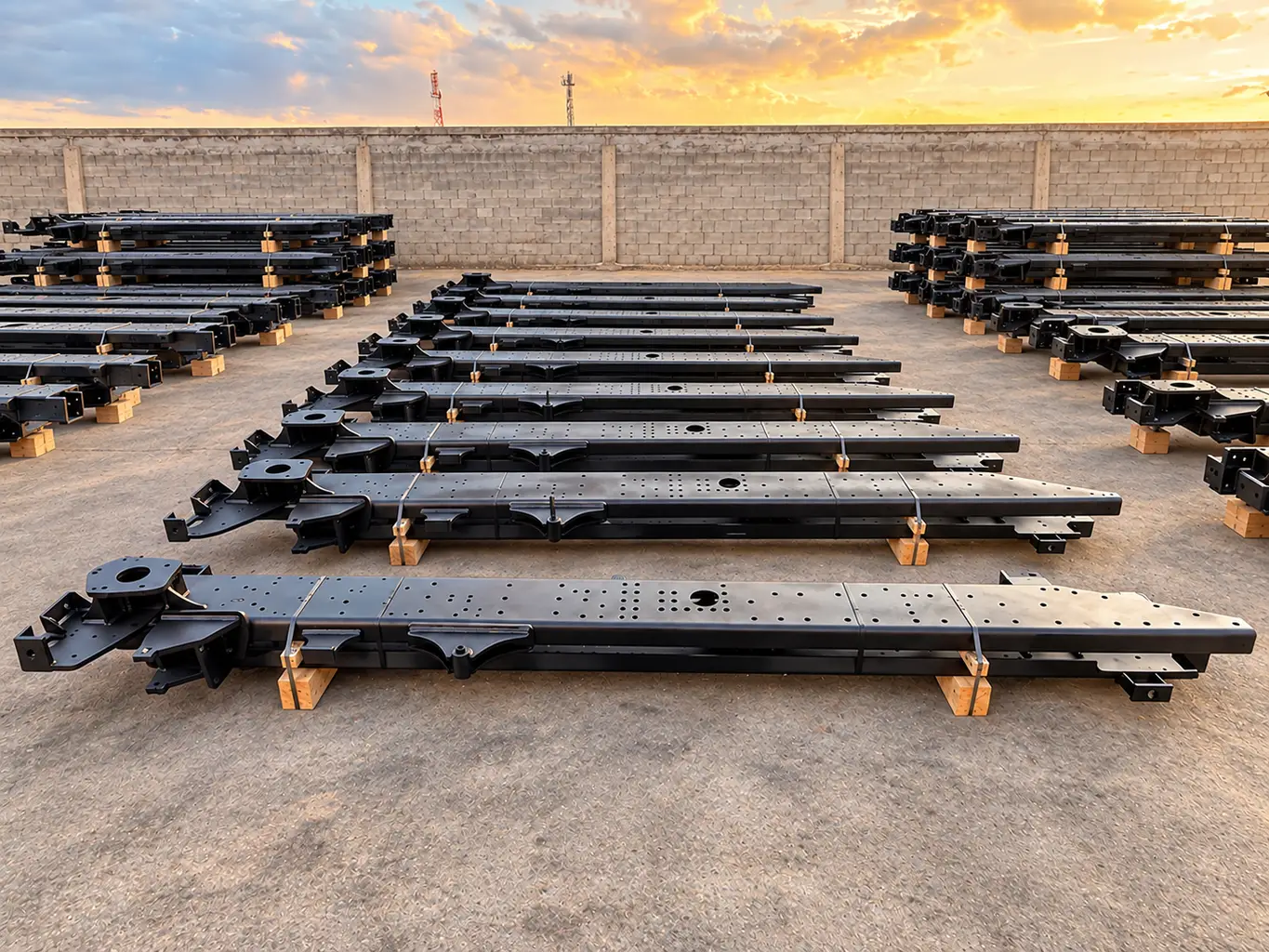
A heavy truck frame rail manufacturer is not selected on steel capacity alone. The supplier must be able to process long parts without losing dimensional control, execute repeatable welding where assemblies require it, inspect critical geometry, and support the documentation expected in an OEM production program. A rail that meets nominal dimensions at one station but accumulates variation through cutting, forming, welding, and handling can create fit-up issues far downstream.
For purchasing teams and manufacturing engineers, the practical question is whether a supplier’s equipment, process controls, and quality resources match the rail design and production schedule. That evaluation becomes more important as rail length, material thickness, formed geometry, and attached subassemblies increase.
What heavy truck frame rails demand from a supplier
Frame rails are long structural components, so small deviations can become significant across the finished part. Straightness, flange position, web geometry, hole location, and the relationship between mounting features all affect how crossmembers, brackets, suspensions, powertrain supports, and body equipment assemble.
The manufacturing route must also reflect the part design. Some programs require extensive laser-cut features before forming. Others require formed rails with welded reinforcements, brackets, or crossmember interfaces. The right sequence depends on the drawing, material specification, critical datums, and how the component will be fixtured and inspected.
A qualified supplier should be prepared to review more than a flat pattern. The review should consider rail length, formed profile, steel grade and thickness, feature density, weld requirements, component weight, handling needs, annual or weekly volumes, and required delivery cadence. These factors determine whether the process can be repeated efficiently rather than merely completed once.
Long-part cutting and forming capacity
The equipment envelope is a basic but meaningful qualification point. A machine that cannot accommodate the rail in a stable setup may force additional operations, repositioning, or part segmentation. Each added handling step can introduce complexity and potential variation.
IONSA operates a 30 kW fiber laser with a 16-meter cutting bed and a 2,400-ton CNC press brake with 53 feet of forming length. For long chassis rails and large heavy-steel components, this combination supports processing within a large working envelope. It also allows engineering discussions to start from the actual component dimensions rather than from an assumed standard part size.
Why forming length matters
A long frame rail must be formed with consistent geometry over its working length. Press brake tonnage matters because it must suit the material and bend requirements, but forming length matters just as much for a full-length rail. A supplier should evaluate the requested profile against both capabilities, rather than discussing tonnage as a stand-alone number.
Part design can influence the best forming approach. Deep channels, multiple bends, high-strength material, and tight geometric relationships may require additional planning for tooling, bend sequence, springback, and material handling. The supplier should identify these considerations during engineering review, before production tooling and schedules are committed.
Cutting features in the correct process sequence
Laser cutting can produce rail blanks and integrated features such as openings, slots, and mounting locations when the design calls for them. However, the order of cutting and forming requires engineering judgment. Features located near bends, datum-dependent dimensions, and distortion-sensitive areas may need specific process controls.
The objective is not simply to cut every feature as early as possible. It is to establish a sequence that supports dimensional requirements after all relevant operations are complete. This is one reason OEM teams should provide current drawings, revision status, critical characteristics, and inspection requirements at the quotation stage.
Welding quality for rails and heavy subassemblies
Many heavy truck programs include more than a formed rail. They may require welded brackets, reinforcement plates, crossmember interfaces, or other heavy subassembly content. Welding then becomes part of the dimensional strategy, not a separate downstream activity.
Weld heat can affect geometry, particularly on long or formed components. Fixture design, weld sequence, joint access, material condition, and handling all influence the finished part. A supplier should be able to distinguish between a part that is weldable and a process that is suitable for repeatable production.
IONSA has 150+ welding stations and an in-house AWS Certified Welding Inspector. Those resources support a production environment where weld execution and inspection are considered alongside fabrication flow. The required weld procedure, acceptance criteria, inspection method, and documentation should still be defined according to the customer’s drawings and program requirements.
Inspection must follow the datums that matter
Checking a few overall dimensions is not enough for a frame rail or subassembly. Inspection should be tied to the datums and functional interfaces identified by the engineering drawing. That may include rail profile, feature locations, bracket positions, weld-related geometry, and the relationship between multiple attachment points.
Creaform dimensional inspection equipment can support measurement of large, complex fabricated parts. The appropriate inspection approach depends on the component’s critical characteristics, production volume, reporting requirements, and the point in the process where verification is most useful. First-article review, in-process checks, and final verification serve different purposes and should not be treated as interchangeable.
Traceability and production control are part of supplier qualification
For OEM programs, traceability is a production requirement rather than an administrative add-on. Purchasing and quality teams need confidence that material, routing, inspection activity, revisions, and production status can be managed in a controlled manner.
An ERP system helps connect job information to the manufacturing process. IONSA uses MIETrak ERP to support production management and traceability. For customers, the value is practical: a clearer basis for managing part revisions, production routing, work status, and records associated with the program.
Quality-system expectations also vary by industry and contract. IONSA holds AAR M-1003 certification, which is relevant to its work supporting freight rail manufacturing. Heavy truck customers should define their own required certifications, quality clauses, record retention expectations, and customer-specific requirements during the supplier qualification process. A certification alone does not replace a program-specific quality plan.
Questions to ask a heavy truck frame rail manufacturer
A useful supplier review focuses on how the manufacturer will produce the specific rail, not on general claims of fabrication capability. Ask whether the part can be laser cut and formed within the available machine envelope, how the supplier will control long-part geometry, and which dimensions will be verified against drawing datums.
For welded assemblies, ask how fixturing, weld sequence, and inspection will be addressed. For recurring production, ask how the supplier will manage revision control, material identification, inspection records, and production scheduling. These questions give engineering, purchasing, and quality teams a common basis for comparing suppliers.
Cost should be evaluated in that same context. A lower piece price may not represent lower program cost if the supplier needs multiple setups, extensive outside processing, or added handling to accommodate the rail. Conversely, a larger manufacturing envelope is not automatically the right answer if the supplier has not defined the inspection and process controls required by the drawing.
Start with a manufacturing review
The most productive first step is a drawing-based review that identifies the part’s physical and program requirements. Provide the current drawing revision, quantities, rail dimensions, material information, component weight, weld requirements, critical characteristics, target delivery schedule, and any quality documentation requirements. This gives the manufacturing team enough information to assess process fit and identify questions before quotation or production planning.
For heavy truck frame rails, the best supplier relationship starts with clear technical input and a direct discussion of how the part will move from cut blank to inspected component. That early work helps establish a manufacturing path that supports repeatable production when the program moves beyond the first part.
Discuss your production requirements
Explore IONSA’s Heavy truck subassembly fabrication. Request a quote and upload your drawing with the current revision, material, quantities, overall dimensions, component weight, delivery schedule, and required inspection records. IONSA will review drawing-specific feasibility before confirming tolerances, capacity, or lead time.