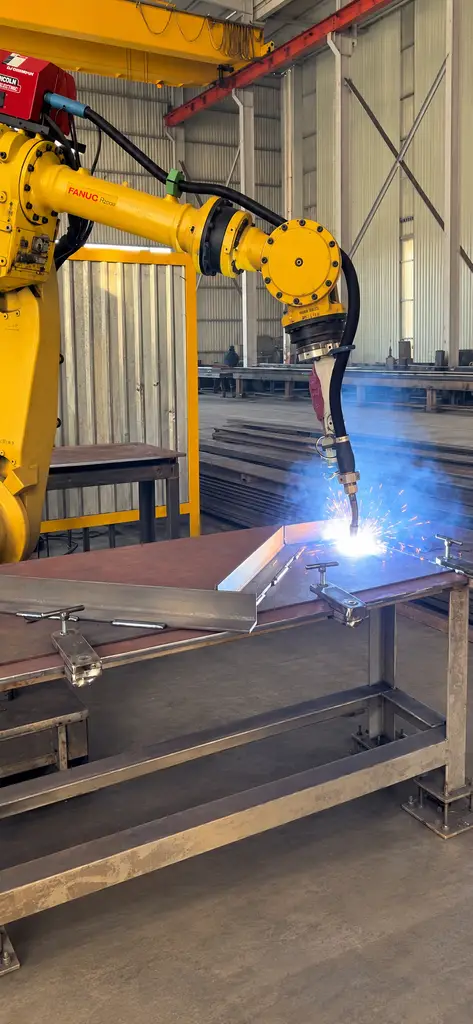
Long weld seams on heavy truck frame rails can create variation that is difficult to control when fit-up, joint access, and part location change from one component to the next. Robotic welding services are most effective when they are treated as a complete manufacturing process rather than a machine selection. For OEM buyers, the relevant question is not simply whether a supplier uses robotic welding. It is whether the supplier can produce the required joint quality, dimensional condition, inspection records, and throughput for the specific drawing and production schedule.
For heavy truck subassemblies, transformer tanks, large freight rail components, and data center structures, welding method selection begins upstream. Material condition, formed geometry, weld symbols, sequence requirements, and inspection criteria all affect whether automation is appropriate and how the work must be controlled.
What robotic welding services should address
A robotic welding system can repeat a programmed weld path, but repeatability depends on the parts arriving at the cell in a repeatable condition. Variation in laser-cut edges, press brake forming, component placement, tack welding, or fixture wear can affect torch position and final weld results. This is especially relevant for long structural assemblies, where small changes can accumulate across the length of a rail or fabricated structure.
A capable robotic welding process therefore includes part preparation, stable fixturing, welding procedure requirements, program control, and inspection planning. The robot handles a defined operation. The manufacturing system must control the conditions around it.
For a heavy truck frame rail or crossmember assembly, the process may require consistent hole locations, formed profiles, mating-part alignment, and access for the welding torch. For a transformer tank, joint design, weld continuity, enclosure requirements, and customer-specified coating requirements can all influence the process route. Large rail components may introduce additional handling, fit-up, and dimensional verification considerations because of their size and structural function.
Automation is not automatically the right answer for every weld. Low-volume assemblies with frequent engineering changes, inaccessible joint locations, or substantial part-to-part variation may be better served by manual or semi-automatic welding. A manufacturing review should identify where robotic welding adds value and where another method offers better control.
Start with part geometry and upstream fabrication
Robotic welding performance is closely connected to the accuracy and consistency of upstream operations. A weld cell cannot fully compensate for parts that do not locate consistently. Buyers evaluating a welding supplier should ask how cutting, forming, machining, and fixturing are coordinated before welding begins.
IONSA supports heavy steel fabrication with a 30 kW fiber laser on a 16-meter cutting bed and a 2,400-ton CNC press brake with 53 feet of forming length. These equipment ratings are relevant when evaluating long chassis rails, large rail structures, and other heavy fabricated components. They do not establish drawing-specific feasibility on their own. Final feasibility depends on the material, dimensions, geometry, weight, handling requirements, and specified tolerances.
For example, long frame rails may require coordinated cutting and forming so that downstream weld fixtures can establish a consistent datum strategy. A heavy subassembly may need machined or laser-cut features that support repeatable location during fit-up. In each case, the objective is to establish a controlled part condition before welding starts.
Weld sequence also matters. Heat input can affect straightness, flatness, and local geometry, particularly on long or complex assemblies. The correct sequence depends on the joint configuration, material, component stiffness, and dimensional requirements. Buyers should provide any critical datums, functional interfaces, and post-weld dimensional requirements early in the quoting process so the supplier can evaluate fixturing and inspection needs.
Fixturing is a production requirement
A robot can only follow the programmed path relative to the fixture and component location. That makes fixture design a production requirement, not an accessory. Fixtures may need to establish reference points, restrain movement during welding, permit clamp access, and allow loading and unloading without damaging finished surfaces.
The right fixture approach depends on anticipated volume. A dedicated fixture may be appropriate for stable, recurring production. A modular or adjustable fixture can make more sense for lower volumes or assemblies with related variants. Either approach should be evaluated against the drawing, forecast, change frequency, and inspection plan.
For heavy parts, fixture design must also account for safe handling and part support. Component weight, center of gravity, lifting points, and available access can affect how an assembly is presented for welding and inspection. These details should be defined during the manufacturing review rather than left to the start of production.
Welding quality requires documented control
Robotic welding does not remove the need for qualified oversight. Weld acceptance remains dependent on the applicable customer requirements, joint design, welding procedure requirements, material condition, and inspection criteria.
IONSA has more than 150 welding stations and an in-house AWS Certified Welding Inspector. The AWS CWI supports welding inspection activities within the manufacturing operation. It should not be interpreted as independent third-party certification of every weld. The required inspection approach should instead be agreed for the program, including visual inspection, dimensional checks, customer hold points, documentation, and any specified nondestructive examination.
For programs requiring production records, MIETrak ERP can support manufacturing records. The depth of traceability is program-specific and should be defined before production. A buyer may require material identification, lot control, operator or station records, weld inspection results, repair records, or shipment documentation. Not every program needs the same record set, and requesting the needed level at quotation helps align the production plan with quality expectations.
IONSA also maintains AAR M-1003 quality assurance certification within its defined facility and activity scope. For freight rail work, buyers should confirm how their particular component, specification, and documentation needs align with that scope. Certification is useful during supplier qualification, but it does not replace drawing review or customer-specific quality requirements.
Dimensional verification after welding
Post-weld verification matters because a weld can meet visual acceptance requirements while the completed assembly still misses a critical interface or mounting dimension. Heavy truck frames and subassemblies often include hole patterns, brackets, crossmembers, and interfaces that must align with adjacent components. Similar concerns apply to transformer tank features, rail assemblies, and data center steel structures.
Creaform dimensional inspection equipment can support dimensional inspection under an agreed plan. The appropriate plan may include checking overall length, formed profiles, mounting features, critical datums, or assembly relationships. Inspection methods and acceptance criteria should be tied to the drawing and the end-use requirement rather than assumed from the equipment alone.
This is where communication between engineering, quality, and sourcing teams pays off. If a dimension is functionally critical, it should be identified before fixture design and welding sequence are finalized. Waiting until first-article inspection to identify a difficult-to-control condition can create avoidable rework or program delays.
What to provide for a manufacturing review
A useful review of robotic welding services starts with more than a part number. Provide current drawings and revision status, material specifications, quantity expectations, overall dimensions, component weight, and required delivery schedule. Include weld symbols, any welding procedure requirements, dimensional tolerances, inspection requirements, packaging needs, and customer-specific documentation expectations.
For coated transformer enclosures or related fabricated equipment, provide the applicable customer-specified coating requirements. IEEE C57.12.28 may be relevant to pad-mounted equipment enclosure integrity requirements, but applicability and compliance expectations should be defined by the customer rather than assumed as a blanket certification.
For buyers in the United States and Mexico, manufacturing from Monclova, Coahuila can support cross-border supply programs when commercial, logistics, and production requirements are aligned. The practical review remains the same: confirm the drawing-specific manufacturing route, required controls, and program schedule before committing to a process.
Request a quote from IONSA with drawings, material, quantity, dimensions, component weight, production schedule, and inspection requirements. That information gives engineering and production teams the basis to determine whether robotic welding, manual welding, or a combined approach is the most appropriate path for the part.