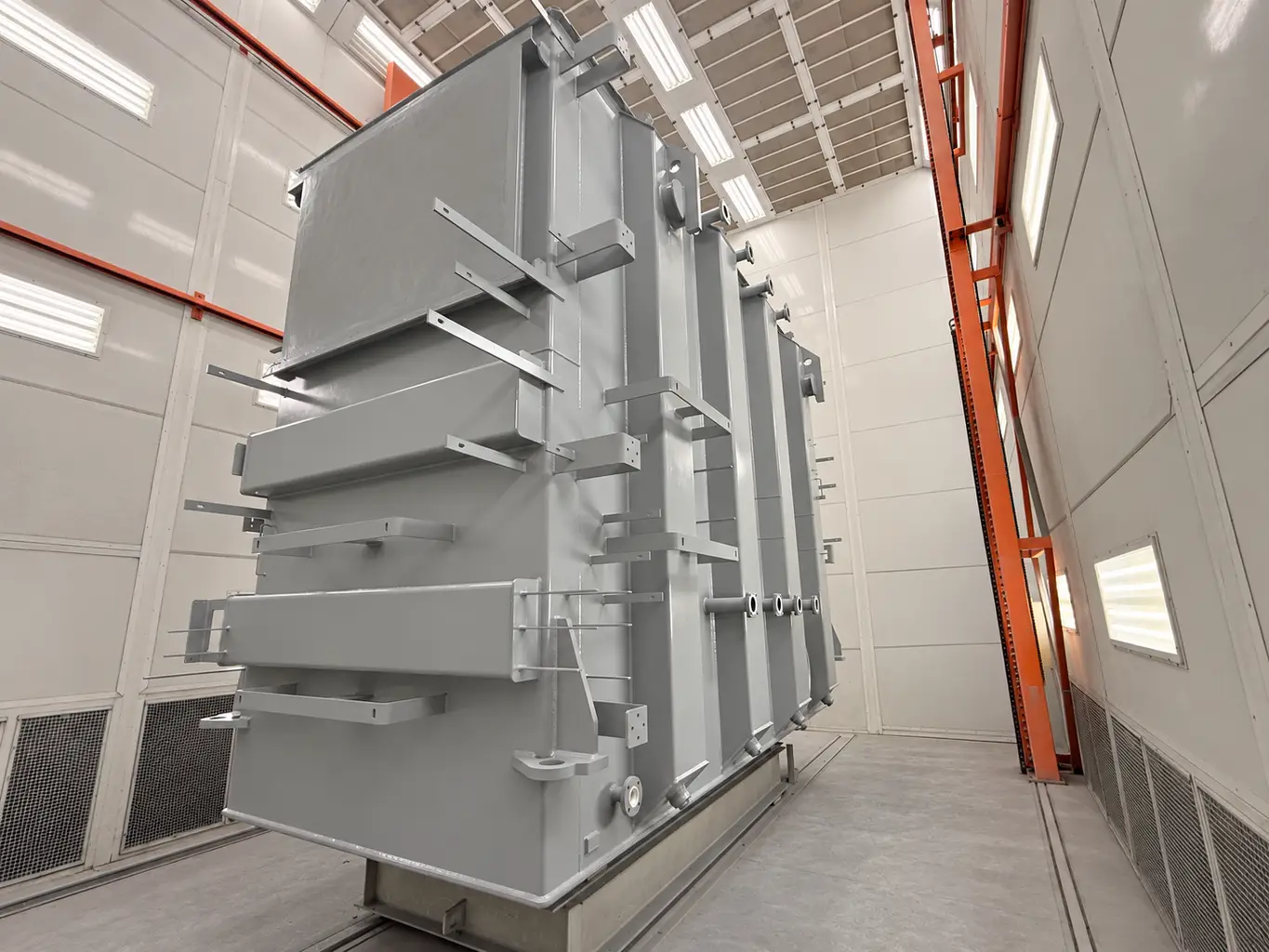
A transformer tank fabrication manufacturer is not simply a source for cut and welded steel. The supplier must turn a drawing package into a dimensionally controlled enclosure that can move through assembly, coating, testing, and delivery without creating preventable fit-up or quality issues. For OEMs, the evaluation starts with whether the manufacturer can repeatedly control large formed components, welded seams, attachments, and inspection records at the required production volume.
Transformer tanks may appear straightforward when viewed as a welded steel structure, but their fabrication demands are cumulative. Plate flatness, bend location, joint preparation, welding sequence, lifting features, flange interfaces, and accessory mounting surfaces all affect the finished assembly. A supplier with the right heavy fabrication equipment can reduce handling and part-to-part variation, but equipment alone does not replace disciplined process control.
What a transformer tank fabrication manufacturer must control
The primary requirement is dimensional repeatability across fabricated sections and final assemblies. Tank walls, covers, stiffeners, base structures, radiator supports, lifting lugs, and connection points must align with the approved design. If formed panels vary from one build to the next, weld fit-up becomes less predictable and downstream assembly teams spend time correcting issues that should have been prevented in fabrication.
Material flow is equally important. Purchasing and quality teams should understand how the fabricator identifies incoming material, separates work orders, and maintains job-level documentation through cutting, forming, welding, inspection, and shipment. The exact traceability requirements depend on the OEM, contract terms, material specification, and application. Still, a manufacturer should be able to explain how material and production records remain connected to the finished component.
Welding quality must be evaluated in the context of the tank design rather than reduced to a generic statement about welding capacity. The relevant questions include whether welding procedures match the joint configuration and material requirements, how welders are qualified and managed, how the manufacturer controls distortion, and how inspection findings are documented and resolved. For assemblies with leak-tightness requirements, the agreed testing method, acceptance criteria, and responsibility for test execution should be established before production begins.
Forming capacity changes the fabrication strategy
Large transformer tank components benefit from forming equipment that can handle long parts in fewer setups. Multiple formed segments can be practical for some designs, particularly when shipping constraints, part geometry, or service access drive the design. However, each additional seam creates another fit-up, welding, inspection, and distortion-control consideration.
A 2,400-ton CNC press brake with a 53-foot forming length provides capacity for long, heavy-gauge formed components that may otherwise require more segmented fabrication. The value is not a claim that every tank wall should be formed in one operation. The value is the ability to review the drawing and choose a forming approach based on material thickness, bend geometry, part length, handling requirements, and production quantities.
For a sourcing team, this is a practical supplier-qualification point. Ask how the manufacturer plans to form the largest parts, what tooling or setup approach is required, and how formed dimensions will be verified. A capable supplier should identify limitations early, before material is released or tooling assumptions become schedule risks.
Cutting accuracy starts with nesting and part identification
The cutting operation establishes the edges, holes, slots, and profiles used throughout the build. In transformer tank work, those features can include panel outlines, cover profiles, stiffener blanks, mounting plates, access openings, and attachment details. When hole patterns or interfaces are inaccurate, the problem is often not visible until assembly.
A 30 kW fiber laser with a 16-meter cutting bed supports processing of large steel plate and long components while reducing the need to divide parts solely to fit a shorter machine bed. This can be relevant when a design includes long structural members or large panels that benefit from consistent feature location from a single programmed setup.
The important discussion is not only laser power or table length. It is whether the supplier has a documented method for program control, first-piece verification, part labeling, and separation of similar components. Large assemblies often include visually similar plates with different hole patterns or orientation requirements. Clear identification at the cutting stage helps prevent wrong-part installation later in the process.
Welding capacity must be matched with welding control
A fabrication floor with 150+ welding stations can support substantial production activity, but capacity should be considered alongside control of the work itself. Transformer tanks and related structures can require long seams, intermittent stiffener welds, attachment welds, and welds in areas that become difficult to access after assembly. The welding sequence should account for access, heat input, distortion, and inspection requirements.
An in-house AWS Certified Welding Inspector adds direct oversight capability during fabrication. The CWI can support verification against applicable welding requirements, visual inspection planning, and disposition of nonconforming conditions according to the project process. The customer should still define the governing drawings, specifications, acceptance criteria, and any required hold points. A CWI is part of the quality system, not a substitute for a complete project quality plan.
Distortion deserves particular attention. Long plate seams and repeated attachment welds can pull panels out of flatness or affect critical interfaces. Manufacturers manage this through fixturing, weld sequencing, controlled handling, and inspection at appropriate stages. The best point to detect a dimensional issue is before the next assembly operation makes correction more expensive.
Inspection should follow the build, not wait until shipment
Final inspection is necessary, but it cannot recover every problem created upstream. Effective dimensional control begins with cut parts and continues after forming, subassembly welding, and major assembly completion. The inspection plan should reflect the design’s critical characteristics, especially mating surfaces, hole locations, envelope dimensions, lifting features, and interfaces with customer-supplied components.
Creaform dimensional inspection equipment can support measurement of complex or large fabricated features where conventional tools alone may be inefficient or insufficient. The right measurement method depends on the feature being checked and the required reporting format. Some projects need targeted verification of a few critical dimensions, while others require broader comparison against CAD data or a defined inspection template.
Purchasing teams should ask what inspection records will be provided, when measurements occur, and how deviations are handled. Manufacturing engineers should also clarify which dimensions are functionally critical. Not every nominal drawing dimension requires the same measurement approach, and focusing resources on functional interfaces produces a more useful quality plan.
Production systems matter for repeat orders
A successful prototype does not automatically demonstrate readiness for production. Repeat transformer tank fabrication requires controlled routing, work-order visibility, revision management, and communication between engineering, production, quality, and shipping. These controls become more important when multiple tank configurations, engineering changes, or phased delivery schedules are active at the same time.
An ERP system such as MIETrak can support production scheduling, material planning, work tracking, and job-level information flow. The operational benefit is clearer visibility into what has been released, what is in process, what remains pending, and where an issue may affect the schedule. The specific reports and records needed should be agreed during program launch, especially for OEMs managing incoming inspection and supplier scorecard requirements.
IONSA manufactures heavy steel fabrications in Monclova, Coahuila, Mexico, for OEM customers in the United States and Mexico. Its equipment base is particularly relevant when tank designs require large cut blanks, long formed sections, and substantial welding capacity, while dimensional inspection and in-house welding inspection support controlled execution.
Build the supplier review around the actual tank design
The strongest supplier review starts with complete information rather than a request for a general capability statement. Drawings should identify revisions, materials, thicknesses, weld symbols, critical dimensions, and any required inspection or test criteria. Quantities and delivery schedules matter because a fabrication approach that works for a one-off assembly may not be the most efficient or controlled method for recurring production.
It is also useful to provide component weights, overall dimensions, packaging constraints, and whether the supplier is responsible for subassemblies only or a more complete fabricated tank structure. If an assembly will be coated, pressure tested, or integrated with purchased components after fabrication, define the handoff condition and any protection requirements for machined or sealing surfaces.
Submit the drawing package, annual or release quantities, largest component dimensions, estimated weights, required delivery dates, and project-specific quality requirements for an engineering-informed manufacturing review. That discussion should identify feasible forming and welding approaches before production decisions are locked in.
Coating requirements and IEEE C57.12.28
Where the project specification calls for IEEE C57.12.28, coating requirements must be reviewed against its scope: pad-mounted equipment enclosure integrity. IONSA can review the specified coating system, preparation, acceptance testing, and records with the OEM. This is a project-specific requirement, not a blanket IEEE certification of all fabricated products. The applicable edition and acceptance criteria should be identified in the quote package.
Discuss your production requirements
Explore IONSA’s Transformer tank fabrication. Request a quote and upload your drawing with the current revision, material, quantities, overall dimensions, component weight, delivery schedule, and required inspection records. IONSA will review drawing-specific feasibility before confirming tolerances, capacity, or lead time.