
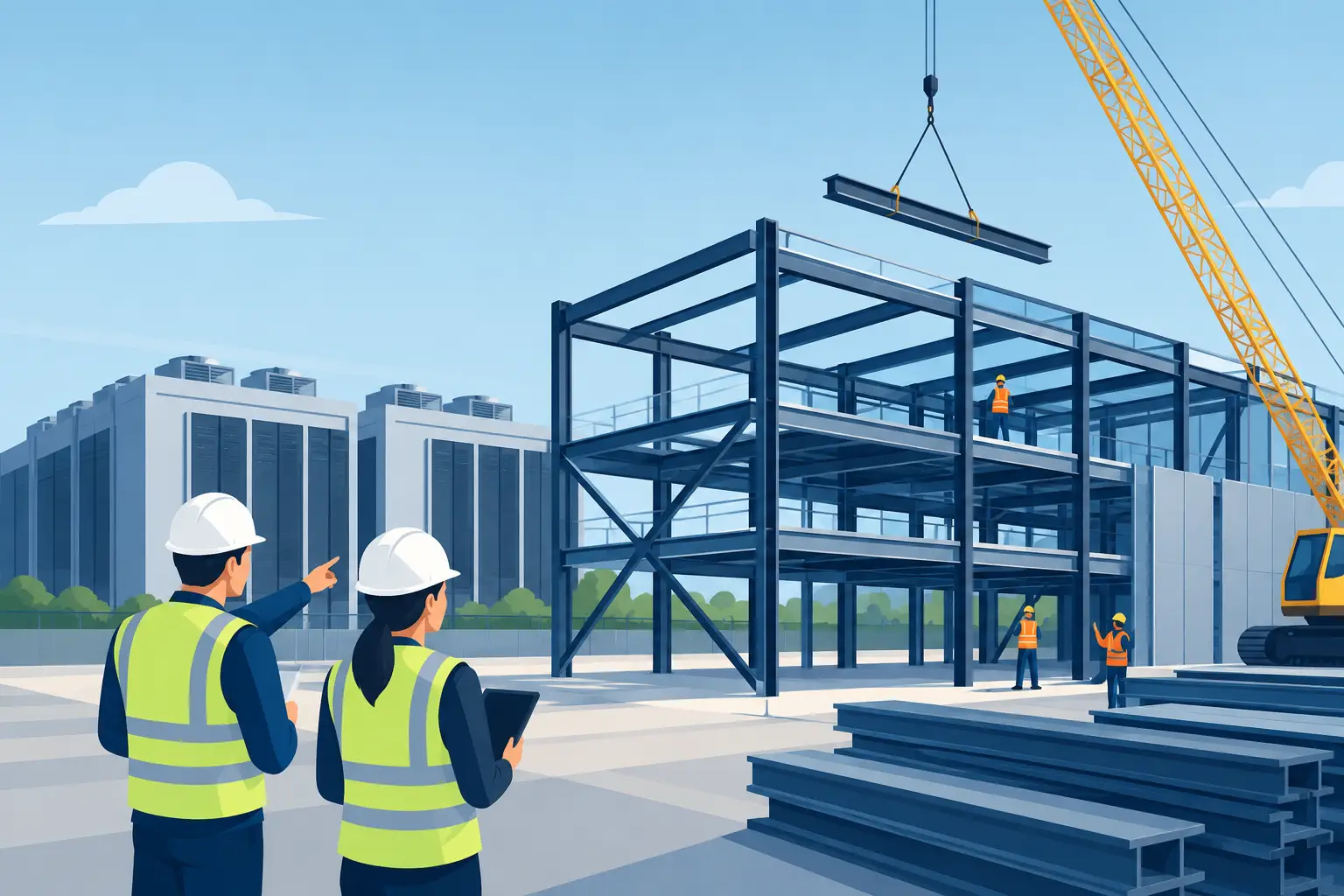
A delayed steel support, equipment base, or enclosure frame can hold up far more than one installation activity. It can affect electrical equipment placement, cable routing, commissioning access, and the turnover sequence for an entire data hall. Data center construction trends are therefore changing how OEMs, fabricators, and project teams define manufacturability before material is released.
For buyers of fabricated steel structures, the main shift is not simply more construction volume. It is the compression of design, procurement, fabrication, delivery, and installation windows. That pressure makes supplier qualification more dependent on documented process control, dimensional planning, welding oversight, material availability, and the ability to manufacture repeatable assemblies at the required production rate.
Data center construction trends are moving decisions upstream
Data center projects increasingly require structural and equipment-supporting steel to be resolved earlier in the program. Owners and contractors want fewer field modifications, while equipment suppliers need interfaces defined before their assemblies reach the site. That places greater value on drawings that identify datum schemes, connection details, lifting provisions, finish requirements, and inspection criteria before fabrication begins.
This is especially relevant for skids, structural frames, containment supports, electrical equipment supports, generator-related structures, and modular enclosure components. A part that is technically producible may still create installation risk if its connection geometry, shipping configuration, or access requirements were not reviewed with the final installation sequence in mind.
For sourcing teams, the practical question is whether the fabricator can participate in an engineering-informed manufacturing review without assuming responsibility for design intent. The review should identify forming constraints, weld access, part orientation, material handling needs, inspection hold points, and practical shipping splits. It should also distinguish between a concept that can be fabricated once and a program that can be produced consistently across multiple releases.
Modular delivery raises the value of repeatable fabrication
Prefabrication and modular construction are gaining attention because site labor, schedule uncertainty, and coordination complexity can be reduced when more work is completed in a controlled manufacturing environment. The trade-off is that dimensional variation becomes more consequential. A mismatch between a support frame and a purchased enclosure, busway route, or equipment interface may not be discovered until the module is already positioned for installation.
Repeatability starts with the production package. Drawings should establish critical dimensions, weld symbols, material grades, coating requirements, and allowable assembly variation. The fabricator then needs process discipline that connects cutting, forming, fit-up, welding, inspection, finishing, and shipment to those requirements.
Long and heavy members deserve particular attention. IONSA’s 30 kW fiber laser has a 16 m cutting bed, and its CNC press brake is rated at 2,400 tons with a 53 ft forming length. Those equipment ratings can support large-format fabrication planning, but drawing-specific feasibility depends on material type, thickness, bend geometry, part weight, handling requirements, and production quantity. Buyers should request a review of the actual part package rather than treating machine capacity as a blanket approval.
IONSA’s work on heavy truck frame rails and heavy truck subassemblies is relevant here because long-part handling, controlled forming, repeatable weld sequencing, and dimensional verification are recurring manufacturing concerns. The same discipline can matter for data center structures where long members, formed channels, and welded subassemblies must arrive ready for controlled installation.
Electrical infrastructure is expanding the fabrication scope
The data center buildout is also increasing demand for electrical infrastructure around the facility. Transformer tanks, equipment enclosures, mounting frames, structural supports, and related fabricated assemblies require coordination among electrical, structural, coating, and transportation requirements.
Not every enclosure or tank requirement is the same. For pad-mounted equipment, IEEE C57.12.28 addresses enclosure integrity considerations, but a fabricator should work to the customer-specified coating and enclosure requirements rather than claim blanket IEEE certification. The required preparation, paint system, film build, masking, hardware protection, and inspection documentation should be clearly defined in the purchase order and drawing package.
The same principle applies to welding. An in-house AWS Certified Welding Inspector supports welding inspection within the manufacturing process, but the applicable acceptance criteria, weld procedures, inspection extent, and customer documentation requirements need to be established for each program. Buyers should avoid vague requirements such as “certified welding” when the product requires specific code references, visual acceptance criteria, nondestructive examination, or reporting.
Quality evidence must match the program risk
Data center projects often involve several organizations: the owner, engineer, general contractor, equipment OEM, electrical contractor, and steel supplier. Documentation requests can grow quickly when assemblies are tied to critical power or cooling infrastructure. The right level of quality evidence depends on the component’s function and the customer’s program requirements.
A useful qualification discussion should cover material certificates where required, welding documentation, first-article or first-piece review, dimensional inspection points, coating records, labeling, packaging, and release authorization. AAR M-1003 certification is relevant to quality assurance within its defined facility and activity scope, while customer requirements may call for additional records or controls beyond that scope.
Production records are equally important when an order is released in multiple lots. MIETrak ERP can support production records, but traceability depth is program-specific. If heat-level material traceability, serialized assemblies, route-card retention, or shipment-level documentation is required, those expectations should be identified before production planning begins.
Dimensional verification should be proportional to the part and interface risk. Creaform dimensional inspection equipment can support inspection under an agreed plan. The inspection plan should identify which features are critical, how datums are established, when parts are measured, and what report format is needed. Asking for “full inspection” without defining the critical features can add cost without improving the information that matters at installation.
Logistics is becoming part of manufacturability
As fabricated assemblies become larger and more integrated, shipping is no longer a final-stage consideration. Weight, length, lift points, trailer constraints, packaging, surface protection, and site unloading capability can influence whether an assembly should be shipped complete or divided into field-connected sections.
There is no universal answer. A larger shop assembly can reduce field welding and improve process control, but it may increase freight complexity and require heavier site lifting. Smaller sections may travel more easily, yet create more field connections and coordination work. The preferred approach depends on route limitations, final assembly access, installation equipment, and the schedule impact of each option.
For cross-border programs serving the United States and Mexico, documentation and shipment sequencing should be considered alongside fabrication planning. The objective is not simply to move steel efficiently. It is to deliver the correct assemblies in the correct installation order, with identifying information and documentation that support receiving and field coordination.
What to provide for a fabrication review
A productive quotation request gives the fabricator enough information to evaluate both manufacturing method and commercial scope. Along with current drawings and revision status, provide the material specification, expected quantity, overall dimensions, component weight, required schedule, and inspection requirements.
It also helps to identify whether the assembly will be painted, galvanized, coated to a customer specification, or delivered for downstream finishing. Include any packaging rules, marking requirements, weld acceptance criteria, critical-to-function dimensions, and special documentation needs. If the design is still developing, state which interfaces are fixed and which are open for manufacturing input.
For data center structures, a clear early review can prevent late questions about long-part forming, weld access, inspection datums, coating coverage, and transport configuration. IONSA can review drawings, material, quantity, dimensions, weight, schedule, and inspection requirements through its request-a-quote process to determine drawing-specific manufacturing feasibility.
The projects that move most predictably are usually the ones where fabrication details are treated as installation decisions, not as paperwork to resolve after steel is released.