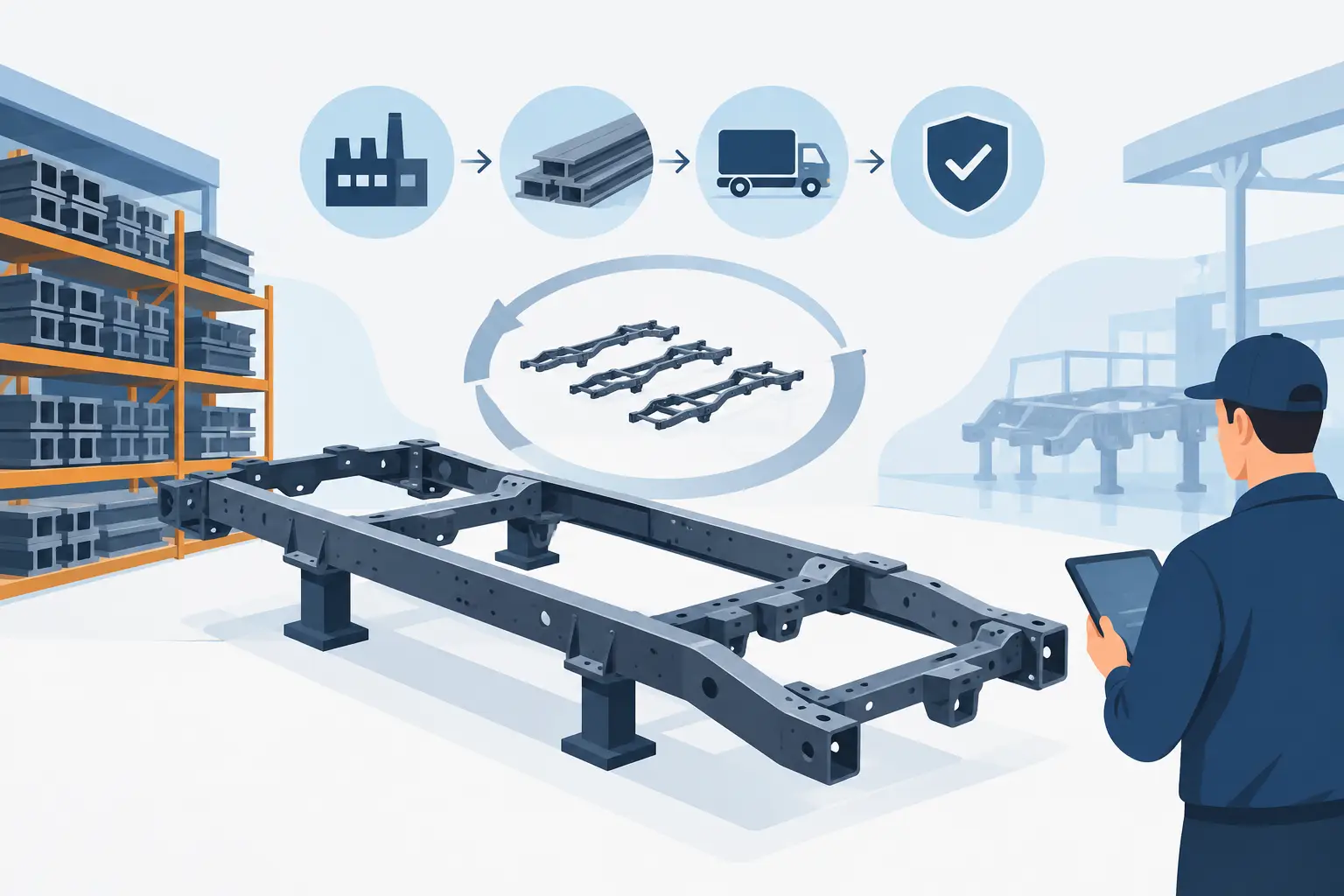
A heavy truck frame rail can look straightforward on a purchase order: material grade, section profile, length, hole pattern, and quantity. The sourcing risk appears when those requirements move through cutting, long-length forming, secondary fabrication, welding, handling, and inspection. A sound frame rail sourcing strategy evaluates the complete manufacturing route, not just quoted piece price or nominal press capacity.
For OEM purchasing and engineering teams, the objective is repeatable rails and subassemblies that fit downstream operations, support vehicle performance requirements, and arrive with the agreed production and quality documentation. That requires early alignment between the drawing package and the supplier’s actual equipment, process controls, and production planning method.
Start with the rail and subassembly, not a generic capability claim
Heavy truck frame rails demand a supplier review that is specific to the part family. Long rails may require laser-cut blanks, controlled forming, holes and features located relative to formed datums, welded brackets or crossmember interfaces, and inspection of critical dimensions after forming. A supplier can have substantial fabrication capacity yet still need to evaluate whether a particular rail length, material, bend sequence, part weight, and handling method fit its process.
The same principle applies to heavy truck subassemblies. A rail with welded reinforcements, mounting brackets, suspension interfaces, or other attached components must be evaluated as an assembly. Welding sequence can influence distortion. Fixture approach can affect hole-to-hole and feature-to-datum relationships. Material flow between cutting, forming, welding, inspection, and shipping can influence both quality and schedule performance.
A productive sourcing conversation begins with the current revision drawing, 3D model where available, bill of materials, annual and release quantities, material specifications, and required delivery dates. It should also identify characteristics that are functionally critical, rather than leaving the supplier to infer their importance from a general tolerance block.
Match frame rail sourcing strategy to the manufacturing route
The best sourcing decision is usually based on whether the proposed route can produce the rail repeatedly at the required volume. This is more useful than evaluating individual machines in isolation.
For long heavy steel components, blank preparation and forming capacity deserve particular attention. IONSA operates a 30 kW fiber laser with a 16-meter cutting bed and a 2,400-ton CNC press brake with a 53-foot forming length. Those equipment ratings support review of long chassis rails and heavy fabricated structures, but drawing-specific feasibility still depends on the material, thickness, developed length, bend geometry, forming sequence, part weight, and required tolerances.
Ask suppliers to explain how they intend to establish datums before and after forming. For example, a hole pattern controlled from a formed flange may require a different process decision than holes located on a flat blank. In some cases, cutting features before forming is efficient and repeatable. In others, post-forming operations or controlled process compensation may be necessary. The correct answer depends on the drawing and validation plan, not a generic preference.
Long parts also require a handling plan. Rail length and mass affect how blanks are loaded, supported through forming, transferred to welding, and positioned for inspection. Unsupported handling can introduce avoidable variation or damage. Buyers should request a review of lifting, support, fixture, and packaging assumptions when components are large enough for deflection or surface protection to become concerns.
Separate forming capability from dimensional commitment
A press brake tonnage rating and forming length establish an important starting point, but they do not establish compliance with every rail drawing. The supplier should review bend radii, flange lengths, springback considerations, material condition, and the dimensional scheme used for acceptance.
This distinction matters most when a rail includes multiple bends, long straightness requirements, or interfaces that must assemble with adjacent chassis components. The purchase order should not rely on phrases such as “standard straightness” when the program requires a measurable acceptance method. Define the required dimensions, datum references, inspection frequency, and reporting expectations during qualification.
Evaluate welding as a controlled assembly process
Many heavy truck frame rail programs involve more than formed channel sections. Brackets, gussets, reinforcement plates, crossmembers, and other attachments may turn the rail into a welded subassembly. In that situation, buyers should assess welding capacity alongside welding control.
IONSA has more than 150 welding stations and an in-house AWS Certified Welding Inspector. This supports manufacturing review and inspection planning for welded heavy steel work. It does not mean every weld is independently third-party certified, nor does it replace program-specific requirements for weld procedures, acceptance criteria, nondestructive examination, or customer approvals.
The practical questions are direct. Which features are welded before final dimensional inspection? What fixture or locating approach controls the assembly? Which welds are safety- or function-critical? How will heat input, weld sequence, and distortion be managed? What documentation is required for the program?
For lower-volume or highly variable subassemblies, flexible fixturing and defined inspection checkpoints may be appropriate. For sustained production, dedicated fixtures and repeatable work instructions can be justified. The sourcing decision should reflect expected volumes and release patterns rather than assuming one approach suits every program.
Define inspection and traceability before production begins
Dimensional inspection is most valuable when it is tied to the component’s functional requirements. A broad inspection report with many noncritical values can be less useful than a focused plan that verifies rail profile, overall length, hole locations, mounting interfaces, and welded feature positions against identified datums.
Creaform dimensional inspection equipment can support inspection under an agreed plan. Measurement method, coverage, reference system, reporting format, and acceptance criteria should be confirmed for the specific program. Do not assume an inspection technology alone defines the accuracy or scope of a delivered report.
Production records should also be specified at the appropriate level. MIETrak ERP supports production records, but traceability depth is program-specific. Some programs may require heat or lot traceability for primary material, while others may require traveler records, inspection results, revision control, weld documentation, or serialized component history. The needed record set should be established in the quality agreement or purchase-order requirements.
For rail components and subassemblies, a practical qualification package often addresses five areas:
- Current drawing and model revision control, including any approved deviations.
- Material requirements, certificates, and the agreed level of lot traceability.
- Critical dimensions, datums, measurement methods, and inspection frequency.
- Welding requirements, acceptance criteria, and required production records.
- Packaging, labeling, shipment configuration, and delivery release expectations.
AAR M-1003 quality assurance certification may be relevant when reviewing a supplier for large freight rail components. Its applicability depends on the defined facility and activity scope, so buyers should confirm how it relates to the work being sourced. For transformer tanks or pad-mounted equipment enclosures, coating and integrity requirements should be reviewed against customer specifications. IEEE C57.12.28-related requirements, where applicable, are not a blanket certification claim and should be addressed in the program’s stated coating and enclosure requirements.
Use capacity discussions to reduce schedule risk
A frame rail sourcing strategy should account for both equipment suitability and production capacity. A supplier may be able to make a first article but lack the planned process flow, staffing, staging area, or release discipline for recurring production. Conversely, a supplier with substantial capacity may need different planning assumptions for prototypes, service parts, and high-volume releases.
Ask how the supplier plans production around forecast demand, release windows, material availability, tooling needs, inspection hold points, and outbound logistics. For United States and Mexico programs, manufacturing in Monclova, Coahuila can be relevant when cross-border freight lanes, supplier communication, and regional supply continuity are part of the sourcing decision. It should be evaluated alongside the full commercial and technical requirements, not treated as a substitute for qualification.
The same framework applies beyond heavy truck rails. Large freight rail components can require long cutting and forming capability, controlled welding, and AAR-related quality review. Transformer tanks may place greater emphasis on formed panels, weld integrity, customer-specified coatings, and enclosure requirements. Data center structures may prioritize dimensional coordination, repeatable fabrication, and project-specific inspection needs. The equipment may overlap, but acceptance criteria and documentation requirements change by application.
Request an engineering-informed manufacturing review
The strongest supplier relationships begin before the quote is finalized. Provide the drawing package, material specification, quantity, dimensions, component weight, schedule, and inspection requirements so the manufacturing team can review the proposed route against the actual work.
Submit those details through IONSA’s Request a Quote form for a review of heavy truck frame rails, heavy truck subassemblies, transformer tanks, large rail components, or data center structures. A clear drawing package and defined acceptance plan give both teams a better basis for deciding whether the process can support repeatable production from the first release onward.