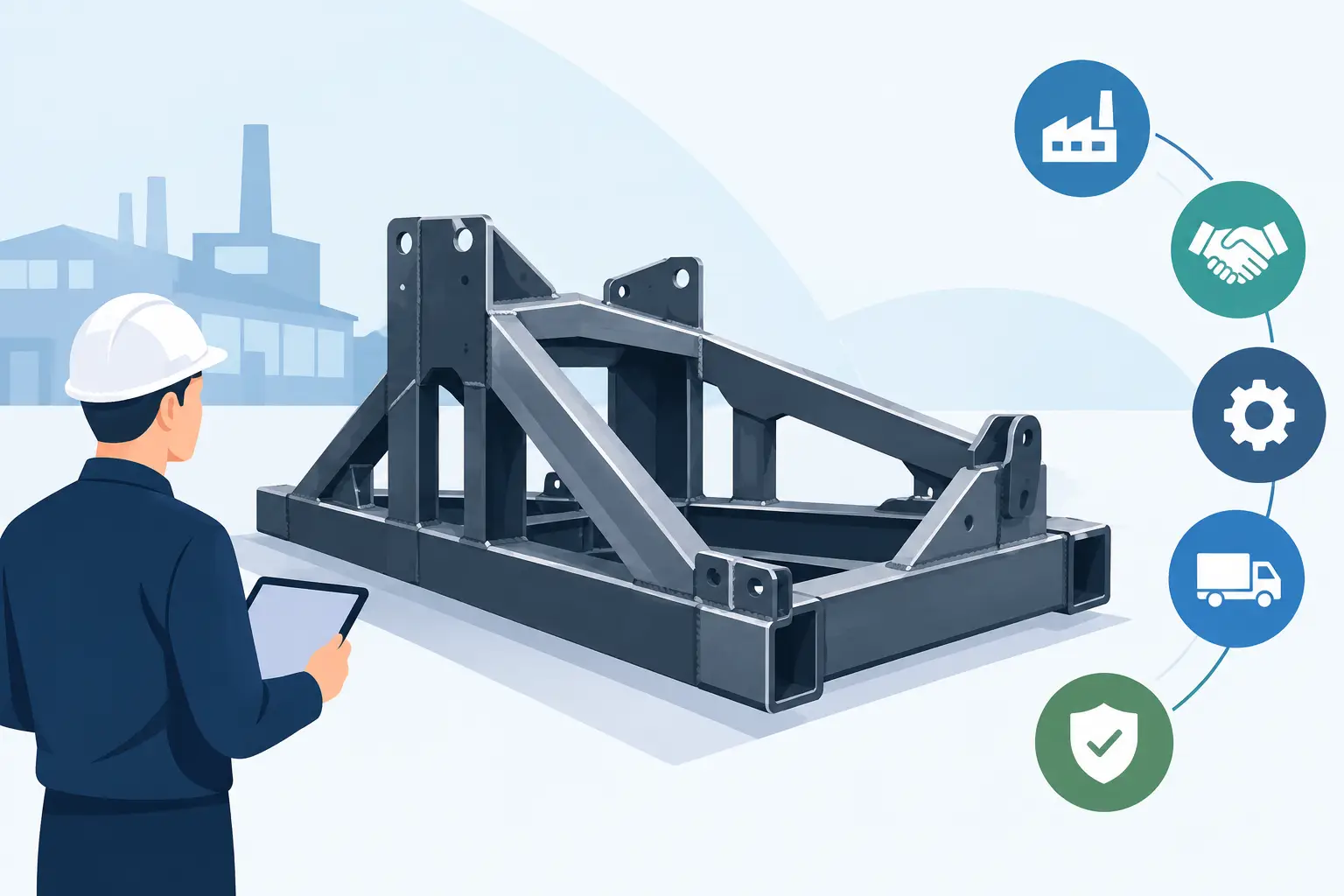
A long truck frame rail can look straightforward on a drawing, then become difficult when it moves through cutting, forming, welding, handling, inspection, and shipment. The large weldment sourcing guide for OEM buyers starts with that reality: supplier qualification must address the complete manufacturing route, not just whether a shop can weld steel.
For heavy truck frame rails and heavy truck subassemblies, small process variations can affect hole location, assembly fit, weld access, distortion, and downstream installation. The same applies to transformer tanks, large freight rail components, and structural steel assemblies for data centers. A sourcing decision should therefore connect the drawing requirements to verified equipment capacity, inspection planning, production controls, and the supplier’s ability to repeat the process at the required volume.
Define the weldment before requesting quotes
A useful RFQ does more than provide a PDF drawing. It tells the supplier what must be controlled and what may vary. This distinction matters with large fabrications because dimensions can be influenced by material condition, forming sequence, weld shrinkage, fixturing, and handling.
For a heavy truck rail or crossmember assembly, identify the functional datums, critical hole patterns, straightness or flatness requirements, weld symbols, material grade, and coating or finishing requirements. If the assembly interfaces with customer-supplied parts, include the mating conditions or an assembly model where available. Suppliers need this information early to determine whether inspection should occur before welding, after welding, or at several process stages.
Part weight and overall dimensions are equally relevant. They affect lifting, fixture design, material flow, and freight planning. A supplier may have a press brake or laser bed large enough for the blank, yet still need to assess whether the complete fabricated assembly can be safely manipulated and inspected. Equipment ratings establish available capacity, but drawing-specific feasibility requires engineering review.
When the application is a transformer tank, clarify the required leak-testing approach, enclosure details, grounding features, and customer-specified coating requirements. IEEE C57.12.28 may inform requirements for pad-mounted equipment enclosure integrity, but it should not be treated as a blanket certification for a fabricator or coating system. For rail components, define the governing customer, railroad, or industry requirements and the documentation expected with each shipment.
Use this large weldment sourcing guide to assess process fit
The most capable supplier is not automatically the best fit. The relevant question is whether its process envelope supports the specific part family, quality plan, and production cadence your program requires.
Start with material preparation. Long chassis rails and large structural members benefit from equipment that can process substantial sheet or plate dimensions without unnecessary material breaks. IONSA operates a 30 kW fiber laser with a 16-meter cutting bed, which can support the processing of long components when the part geometry, material, and production plan are feasible for the machine. Confirm the actual nesting strategy, cut features, edge-quality expectations, and any secondary operation required by the drawing.
Forming capacity requires the same level of review. A 2,400-ton CNC press brake with a 53-foot forming length is a meaningful resource for long formed truck components and large fabricated structures. However, tonnage demand depends on material type, thickness, bend length, tooling, bend radius, and forming sequence. Ask the supplier to review the drawing rather than assuming that a long bed or high tonnage rating alone qualifies the part.
Welding is where large assemblies often gain or lose repeatability. The number of welding stations indicates available production infrastructure, but the important questions are more specific: How will the part be located? Which welds are made in which sequence? Where is distortion expected? How are weld access, preheat needs, and post-weld inspection handled? A supplier with more than 150 welding stations can support varied fabrication work, but the program still needs appropriate fixtures, qualified procedures where required, trained personnel, and a documented inspection plan.
Qualify dimensional control and welding quality separately
Dimensional inspection and weld quality are connected, but they are not the same control. A weld can meet its acceptance criteria while the assembly moves out of position because of heat input or an inadequate fixture. Conversely, a dimensionally acceptable part can still require weld discontinuity evaluation under the applicable code, customer standard, or work instruction.
Ask how critical dimensions will be established from datums and how the supplier will verify the condition after major process steps. Creaform dimensional inspection equipment can support measurement under an agreed inspection plan, particularly where large geometry or complex fabricated assemblies make conventional point measurement insufficient. The inspection method, reporting format, sampling plan, and acceptance criteria should be agreed before production. Do not assume a particular measurement accuracy without reviewing the specific part, setup, and inspection method.
For welding oversight, verify who reviews workmanship requirements, inspection criteria, and nonconformance disposition. IONSA has an in-house AWS Certified Welding Inspector. That capability supports internal welding inspection activities; it does not mean every weld receives independent third-party certification. If your program requires specific weld procedure documentation, nondestructive examination, customer witnessing, or third-party inspection, state it in the RFQ so the requirement can be planned and priced correctly.
Make traceability proportional to the program risk
Traceability is often requested broadly and defined poorly. A production weldment may need material heat traceability, consumable records, operator identification, inspection reports, revision control, and shipment-level documentation. Another program may only require lot identification and final inspection evidence. Both can be appropriate depending on the end use, contractual requirements, and consequences of failure.
Define the records you need to receive, retain, and retrieve. MIETrak ERP supports production records, but traceability depth is program-specific and should be established in the quality plan. This avoids a common sourcing problem: the buyer expects serialization or material-level traceability after award, while the quoted process was built around basic lot control.
A practical qualification package should address at least these six items:
- Current drawings, models, revision status, and critical characteristics.
- Material specifications, approved alternatives, and required certificates.
- Annual volumes, release quantities, and forecast variability.
- Dimensional and welding inspection requirements.
- Required production, quality, and shipment documentation.
- Launch timing, ongoing delivery schedule, and change-control expectations.
This level of definition helps purchasing compare suppliers on the same basis. It also gives manufacturing engineers enough context to flag risks before tooling, fixtures, or production schedules are committed.
Evaluate capacity beyond the first article
A first article can be successful while serial production still struggles. Large weldments consume floor space, fixture capacity, welding time, inspection time, and handling resources. The supplier should be able to discuss how it will move from prototype or pilot work into recurring production without changing key process conditions unexpectedly.
Ask about the planned routing for the part family, including laser cutting, forming, machining where applicable, welding, inspection, and packaging. For heavy truck subassemblies, consider whether related components can be produced and controlled as a coordinated assembly rather than sourced as disconnected pieces. This can reduce handoffs, although it may not be the best option when specialized processes or customer-directed sourcing are required.
Location can also affect the commercial review. For OEMs operating in the United States and Mexico, manufacturing in Monclova, Coahuila can support cross-border supply planning. Freight lanes, border documentation, packaging requirements, and delivery frequency should still be evaluated for the actual program rather than assumed from geography alone.
Request an engineering-informed manufacturing review
Review IONSA’s heavy fabrication and machining capability information alongside the actual drawing package, not as a substitute for it. The most useful next step is to submit drawings, material specifications, quantity, overall dimensions, component weight, schedule, and inspection requirements through the request-a-quote process. Include any customer standards, required records, coating requirements, and mating-part information that could affect the manufacturing route.
A well-defined RFQ gives both teams a better starting point: the buyer receives a quote based on the real production requirement, and the fabricator can identify process questions before they become production problems.