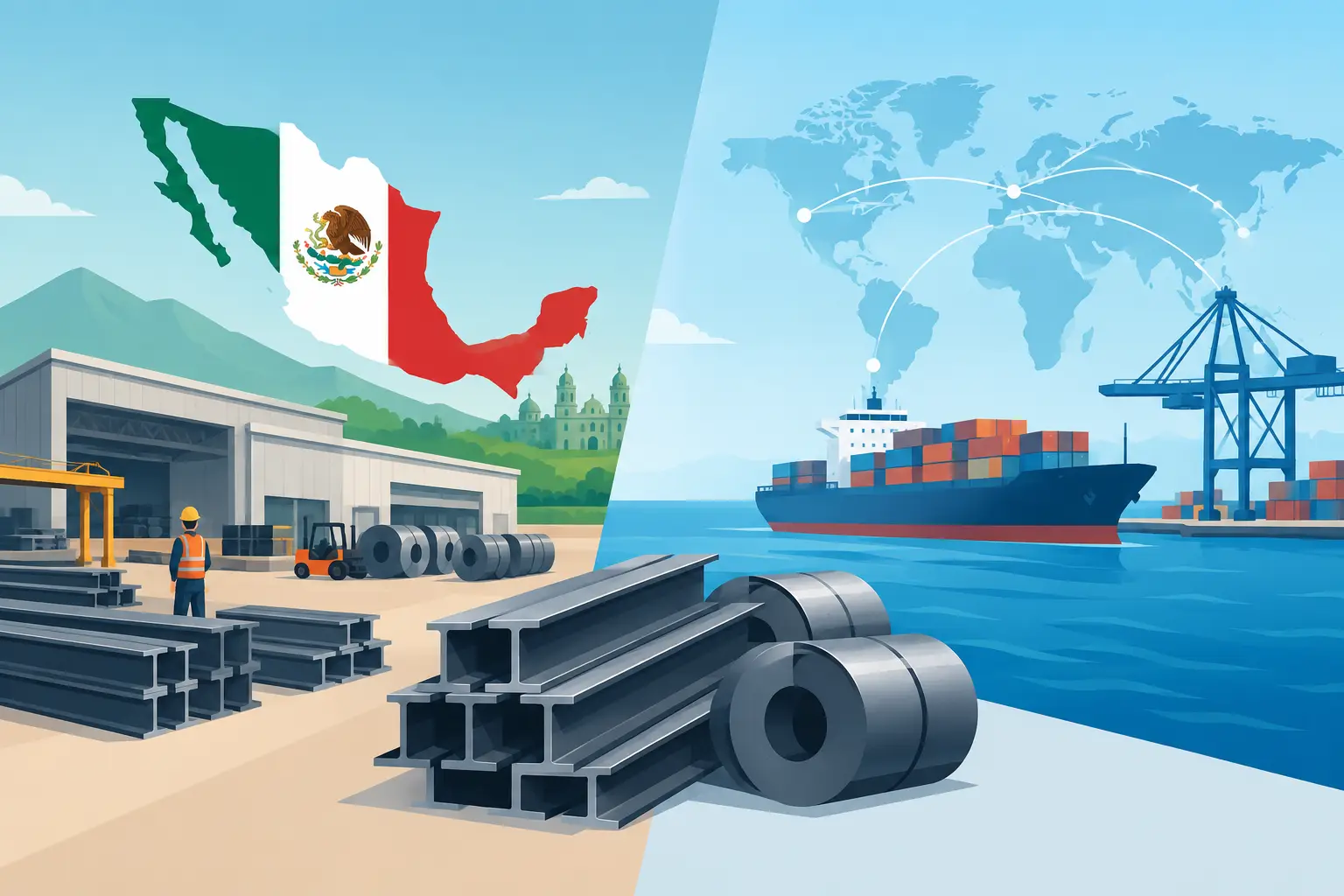
A heavy truck frame rail that arrives late, forms inconsistently, or requires rework at final assembly can erase a favorable piece-price quote quickly. Mexico versus offshore sourcing is therefore not simply a geographic comparison for OEM purchasing teams. It is a decision about forming capacity, welding control, freight exposure, engineering communication, and how reliably a supplier can execute the requirements defined in the drawing package.
For heavy truck frame rails and heavy subassemblies, the right source depends on the full manufacturing and delivery system. The same applies to transformer tanks, large freight rail components, and fabricated steel structures for data centers, where component dimensions, weld requirements, handling needs, and inspection expectations can make logistics as consequential as labor cost.
Mexico versus offshore sourcing: evaluate total manufacturing risk
Offshore sourcing can be appropriate when annual volumes are stable, specifications are mature, shipment consolidation is practical, and a buyer can carry the inventory needed to absorb longer transit cycles. Suppliers located farther from the United States may also be a fit for parts with low engineering-change frequency and limited urgency for in-process issue resolution.
The trade-off is that the quoted unit price is only one part of the decision. Procurement teams should evaluate total landed cost alongside working capital, packaging, ocean or air freight exposure, customs administration, inventory buffers, port variability, and the cost of responding to a nonconformance. For large fabricated steel parts, transport planning and damage prevention deserve the same attention as the fabrication quote.
Mexico-based manufacturing can reduce physical distance between a fabrication facility and U.S. assembly operations. That proximity may support more practical engineering discussions, supplier visits, first-article coordination, and shorter ground-freight lanes than a transoceanic supply route. It does not remove the need for disciplined cross-border documentation, customs planning, or carrier coordination. It does change the recovery options available when a schedule, revision, or quality issue needs attention.
The useful question is not whether Mexico is universally better than offshore sourcing. It is whether the proposed supply model fits the component’s size, demand pattern, revision risk, inspection plan, and operational consequences of disruption.
Start with the part, not the country
Heavy fabrication programs should be qualified against drawing-specific requirements before a sourcing region is selected. A long rail, formed structural member, tank shell, or welded assembly may require a particular material grade, bend geometry, weld access, lifting strategy, fixture approach, and inspection sequence. These requirements determine whether a supplier’s equipment can produce the part repeatably.
For example, long heavy truck frame rails may benefit from a fabrication route that keeps cutting and forming aligned with the length of the part. IONSA operates a 30 kW fiber laser with a 16-meter cutting bed and a 2,400-ton CNC press brake with a 53-foot forming length. Those are equipment ratings, not an automatic approval for every rail design. Drawing review must still confirm material, section geometry, bend sequence, tooling needs, handling, and dimensional requirements.
The same principle applies to heavy truck subassemblies. The supplier should assess whether fabricated components can be positioned, welded, inspected, and moved without creating avoidable variation. A high station count may support production flow, but repeatability also depends on welding procedures, fixturing, part presentation, welder qualification requirements, and the agreed inspection plan.
For transformer tanks, buyers should clarify panel sizes, seam details, penetration locations, flatness requirements, leak-test expectations where applicable, surface-preparation requirements, and customer-specified coating criteria. Where a program references IEEE C57.12.28, the scope should be understood as applicable customer-specified enclosure integrity or coating requirements, rather than a blanket claim that every fabricated tank is certified to that standard.
Compare logistics by component size and schedule sensitivity
Freight is not a separate downstream activity for oversized steel fabrication. It affects how components are nested, where lifting points are located, how assemblies are protected, and whether a shipping configuration creates risks during handling.
Offshore transportation can work well when containerization or consolidated loads are efficient and delivery demand is predictable. It becomes more complex for long chassis members, large rail structures, and assemblies that require specialized loading or careful support. A buyer may need more finished-goods inventory to protect an assembly schedule against extended transit or port delays.
Ground transportation from northern Mexico can offer a different planning model for U.S. and Mexican OEMs. The potential value is responsiveness, not a guaranteed transit promise. Actual performance depends on pickup schedules, border procedures, load dimensions, carrier capacity, destination requirements, and the commercial terms of the program. Purchasing and logistics teams should model these variables before assigning the business.
A practical comparison should also include the impact of engineering changes. If a revised hole pattern, reinforcement, bracket location, or weld detail is issued after production has begun, buyers should know what inventory is in transit, what material is committed, and how quickly the supplier can receive, review, and implement the revision through controlled documentation.
Quality controls must match the program requirements
A supplier qualification process should distinguish between a general capability statement and evidence relevant to the program. For fabricated steel components, that means reviewing the quality system scope, welding controls, inspection resources, production records, and nonconformance process against the buyer’s requirements.
IONSA maintains AAR M-1003 quality assurance certification within its defined facility and activity scope. The company also has an in-house AWS Certified Welding Inspector. This supports welding oversight, but it should not be interpreted as independent third-party certification of every weld. Buyers should define applicable weld acceptance criteria, documentation requirements, hold points, and any required independent inspection in the purchase order and quality plan.
Dimensional verification is equally program-specific. Creaform equipment can support dimensional inspection under an agreed plan, including the defined datum scheme, measurement features, reporting format, and sampling approach. It is not enough to request an inspection report without identifying which critical characteristics control fit, function, or downstream assembly.
Production records supported by MIETrak ERP can help organize manufacturing information. Required traceability depth should be established during program planning because material, process, weld, and inspection traceability needs vary by customer and application. A rail component, truck subassembly, transformer tank, and data center structure may each require a different document package.
Questions that expose sourcing risk early
Before awarding a heavy fabrication program, purchasing, engineering, and quality teams should align on a small set of operational questions. Can the supplier process the part in the required dimensions and material condition? How will the forming and welding sequence protect critical geometry? Which features will be inspected, at what stage, and against which acceptance criteria? What records must ship with the part? How will engineering changes be controlled after material release?
It is also useful to ask how the supplier plans to manage capacity around the required production profile. A facility with more than 150 welding stations may have meaningful welding resources, but the relevant assessment is whether the program has the labor, fixtures, material flow, and inspection support needed at its planned volumes. Capacity should be reviewed against the specific routing, not assumed from a single equipment figure.
For heavy truck frame rails and subassemblies, a cross-functional review involving sourcing, manufacturing engineering, quality, and logistics is typically more informative than comparing quotes alone. The same approach applies to large rail components and data center structures, where an apparently minor fabrication decision can influence transport, installation, and field fit-up.
Choose the sourcing model that supports repeatable execution
Mexico can be a strong sourcing option when an OEM values regional production, practical access to the supplier, and a logistics model suited to heavy fabricated steel. Offshore sourcing can remain viable when volume stability, freight planning, and inventory strategy justify the added distance. Neither option substitutes for drawing-level manufacturability review and a clear quality plan.
For OEM teams evaluating heavy truck frame rails, heavy subassemblies, transformer tanks, large rail components, or data center structures, review IONSA’s heavy fabrication capability information and submit drawings, material, quantity, dimensions, component weight, delivery schedule, and inspection requirements through the request-a-quote form. A useful sourcing decision begins when the supplier can assess the actual part, not just the category it belongs to.