
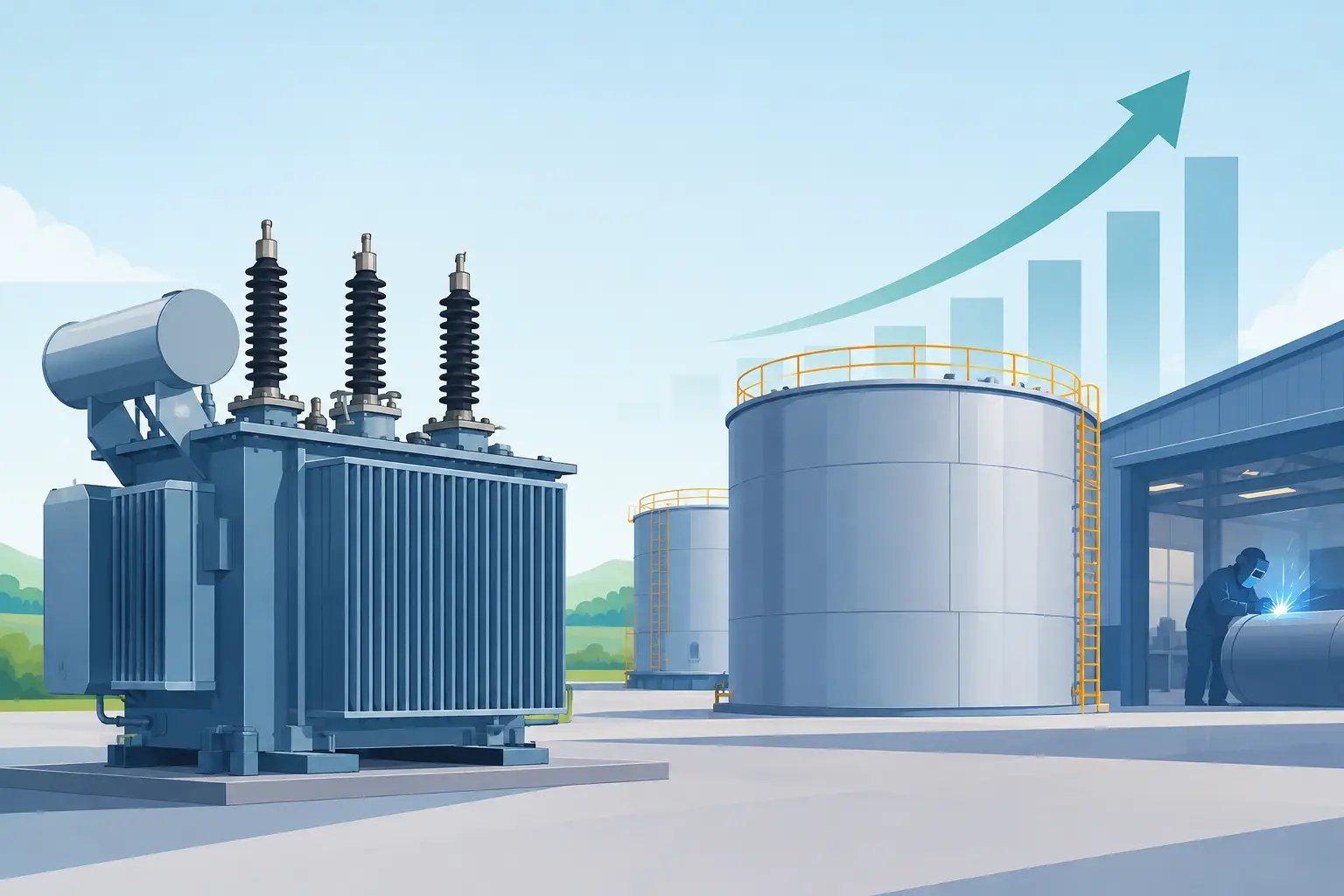
Transformer demand outlook is no longer only a utility planning issue. For OEM purchasing teams and manufacturing engineers, it is a fabrication capacity issue that affects when transformer tanks, covers, radiators, brackets, and structural assemblies must be released, qualified, and built. Demand growth can be uneven by transformer type and region, but the sourcing consequence is consistent: buyers need suppliers that can assess large steel fabrications against the actual drawing package, quality plan, and production schedule.
The strongest programs will not treat tank fabrication as a commodity purchase made after electrical components are secured. Tank design, plate processing, forming, welding, inspection, coating requirements, handling, and transport planning all influence the achievable production schedule. Early supplier involvement gives OEMs a better basis for deciding whether a design is practical to manufacture at the needed volume.
Transformer demand outlook: what is driving requirements
Grid replacement remains a major demand driver. Aging infrastructure, storm hardening, renewable generation interconnection, and load growth require utilities to add or replace equipment across transmission and distribution networks. The mix matters. A large power transformer, a substation transformer, and a pad-mounted distribution unit create different fabrication workloads, even when all are described as transformer demand.
Data center construction adds another layer. Large data center campuses require utility upgrades, substations, and distribution equipment, often on compressed construction schedules. The electrical load may be concentrated in specific markets, which can increase demand for certain transformer categories while also tightening availability of associated fabricated components. Buyers should avoid assuming that a broad market forecast translates directly into a uniform order pattern for every tank design.
Manufacturing bottlenecks also shape the outlook. Electrical steel, conductor material, bushings, tap changers, and other engineered components can determine final transformer delivery. Yet steel fabrication cannot be treated as an unlimited downstream resource. A tank supplier must have available cutting, forming, welding, inspection, and material-handling capacity aligned with the program’s release schedule. A delay in drawings, customer-furnished components, or design approval can compress the fabrication window substantially.
For purchasing teams, the practical question is not simply whether demand is rising. It is whether the selected supplier can repeat the required process for the specific tank family, quantities, dimensions, weights, and inspection requirements involved.
What rising demand changes for transformer tank sourcing
Higher demand places more value on manufacturing discipline. A supplier may have suitable equipment, but drawing-specific feasibility still depends on material grade, plate thickness, bend geometry, weld access, lifting features, distortion controls, handling needs, and inspection criteria. Equipment ratings establish available capacity. They do not replace a manufacturing review of the released design.
Tank fabrication also involves more than joining plate. Buyers should evaluate how the supplier will control part identification, formed-part orientation, fit-up, weld sequencing, dimensional verification, repair documentation where required, and coating preparation. The appropriate level of traceability is program-specific. It should be defined in the purchase order, quality plan, and customer requirements rather than assumed from a general description of an ERP system.
Coating requirements deserve the same attention. Some pad-mounted equipment programs may specify coating and enclosure-integrity requirements associated with IEEE C57.12.28. Those requirements should be flowed down exactly as specified by the customer. A fabrication supplier should not represent blanket IEEE certification based solely on experience with transformer enclosures or the ability to fabricate a tank.
The commercial trade-off is often between flexibility and repeatability. A supplier supporting prototypes and low-volume engineered products may be well positioned for design changes, but that does not automatically establish readiness for sustained production. Conversely, a supplier organized around repeat production may need early forecasts and stable releases to reserve material and labor capacity. OEMs should evaluate both conditions before awarding a program.
Capacity should be reviewed by process stage
Transformer tank sourcing benefits from a process-by-process review. Large plate cutting capacity may reduce the number of seams required in some designs, but the resulting part still needs to be formed, assembled, welded, inspected, and moved safely through production. The limiting operation may be different from one tank configuration to the next.
IONSA operates a 30 kW fiber laser with a 16-meter cutting bed and a 2,400-ton CNC press brake with a 53-foot forming length. These ratings can support the processing and forming of long, large steel components, subject to review of the customer’s drawings and material requirements. For transformer tank programs, that review should address plate nesting, formed geometry, feature locations, flange and reinforcement details, weld accessibility, and whether assemblies can be handled through each manufacturing stage.
Welding capacity also needs context. More than 150 welding stations can support production activity across multiple fabrication programs, including heavy truck frame rails and heavy truck subassemblies, followed by transformer tanks, large rail components, and data center structures. However, station count alone does not establish the needed weld procedure, fixture approach, welder qualification, inspection hold points, or throughput for a specific tank design.
An in-house AWS Certified Welding Inspector can support welding oversight and inspection activities within the agreed quality process. That capability should not be interpreted as independent third-party certification of every weld. Similarly, Creaform dimensional inspection equipment can support verification under an agreed inspection plan, but acceptance criteria, reporting format, datum strategy, and measurement scope must be established for the program.
Questions to resolve before a production award
A supplier review should begin before final purchase order release, especially when transformer demand is creating competition for fabrication capacity. The goal is to identify decisions that can change manufacturing time or quality risk while there is still room to act.
First, confirm the complete technical package. This includes released drawings, bills of material where applicable, material specifications, weld symbols, customer standards, coating requirements, and inspection documentation. A tank drawing without clear requirements for attachments, internal features, leak testing, or surface preparation can lead to avoidable interpretation gaps.
Second, define the production profile. Annual volume is useful, but release quantities, peak monthly demand, prototype needs, service-part requirements, and forecast visibility are more actionable for capacity planning. A supplier may be able to produce the annual quantity in aggregate while still being unable to support the requested delivery pattern.
Third, establish the required quality records. MIETrak ERP can support production records, while the depth of traceability should be agreed based on the customer program. Buyers should identify whether they require heat traceability, weld documentation, inspection reports, nonconformance controls, photo records, or serialization before production begins.
Fourth, review logistics and handling early. Tank dimensions and weight affect lift planning, staging, packaging, cross-border documentation, and freight selection. Manufacturing in Monclova, Coahuila, can be relevant for OEMs serving the United States and Mexico, but the practical evaluation should focus on the program’s shipping lanes, delivery windows, and receiving constraints.
AAR M-1003 quality assurance certification may also be relevant to supplier qualification when the facility scope and activity align with the customer’s requirements. It should be reviewed as a defined quality-system credential, not as a substitute for customer-specific transformer requirements.
Building a more reliable fabrication plan
The current transformer demand outlook supports a straightforward sourcing approach: qualify fabrication capacity before the supply chain becomes critical. Start with the engineering package, then test each process stage against actual part geometry and quality needs. This is more useful than comparing suppliers only by general machine size or quoted unit price.
For OEMs balancing transformer demand with heavy truck, rail, or data center commitments, shared fabrication resources make forecast quality especially valuable. A supplier that understands expected releases can plan material flow, labor loading, inspection activity, and handling requirements with fewer late changes.
Review IONSA’s heavy fabrication and machining capabilities when evaluating large steel fabrication programs. For an engineering-informed manufacturing review, submit drawings, material requirements, quantity, dimensions, component weight, schedule, and inspection requirements through the request-quote form. A clear technical package gives both teams the best chance to identify feasible production paths before capacity becomes the constraint.