A heavy vehicle subassembly guide should start before a purchase order is released. For heavy truck frame rails and welded truck subassemblies, the supplier decision affects fit-up, welding access, handling, inspection planning, production records, and the ability to repeat the build across a program. A low unit price does not correct a rail that cannot be formed consistently or an assembly that requires avoidable rework before final installation.
For OEM purchasing, manufacturing engineering, and quality teams, the practical question is whether a fabricator can produce the part defined by the drawing, at the required volume and schedule, with inspection and documentation aligned to the program. The answer depends on the component design and customer requirements, not on equipment ratings alone.
Start with the subassembly definition
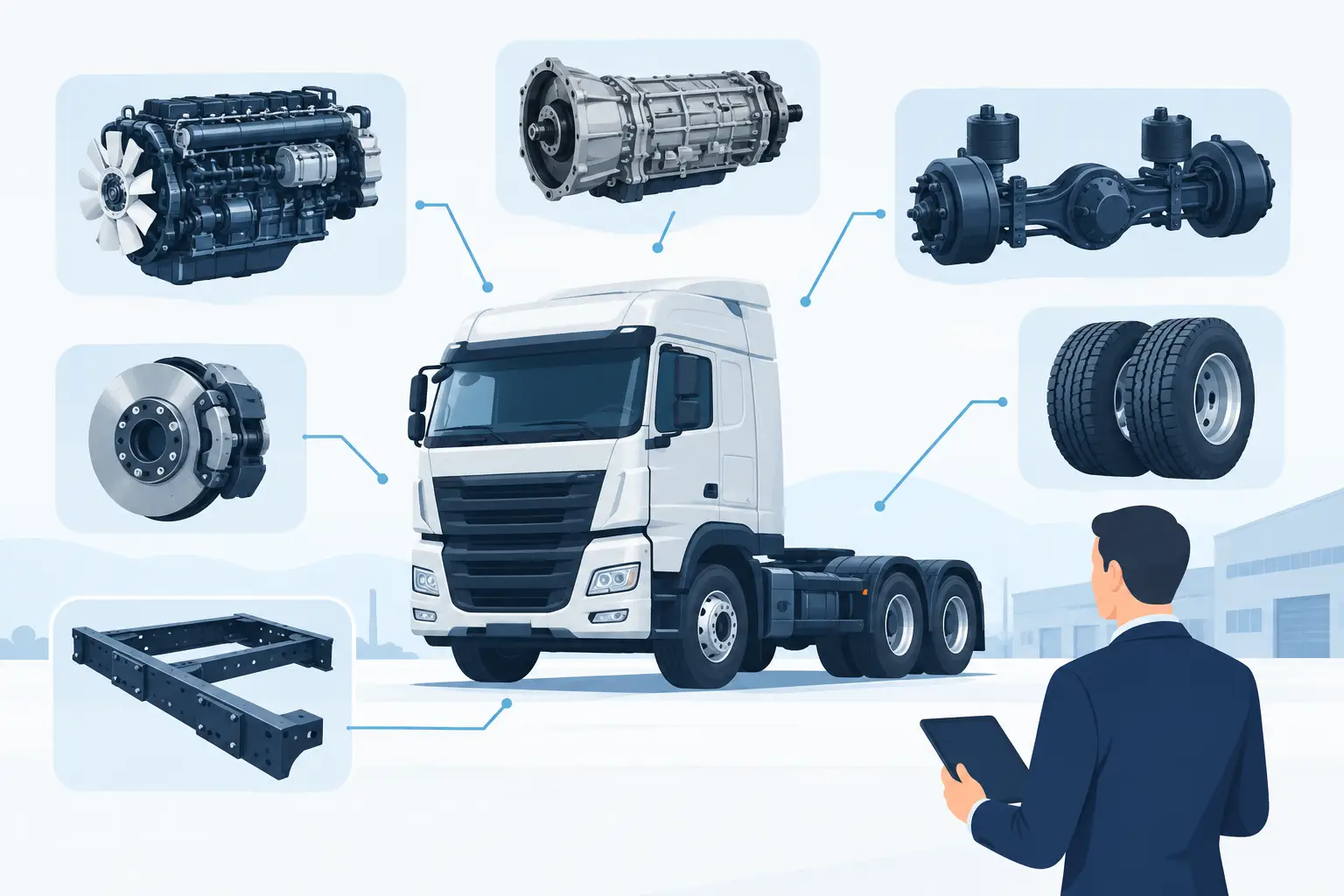
A heavy vehicle subassembly is more than a collection of welded pieces. It is a controlled build that combines cut, formed, machined, and purchased components into an installation-ready structure. In heavy truck applications, that can include frame rails, crossmembers, brackets, reinforcements, suspension interfaces, and equipment mounting features.
The definition should establish the finished condition of the assembly. Drawings need to identify material grades, thicknesses, critical dimensions, weld symbols, datum structure, fastener or bushing locations, coatings, and any machining performed before or after welding. If the assembly has left- and right-hand versions, service holes, formed flanges, or interfaces with customer-supplied components, those details should be clear at quotation rather than resolved during production.
Weight and overall dimensions also matter. They affect lifting plans, welding positioners, fixture design, shipping configuration, and the practicality of moving the assembly between forming, welding, machining, inspection, and coating stages.
Evaluate forming and cutting for long truck components
Long structural parts create risks that are not visible in a flat pattern. A truck frame rail, for example, may require consistent bend geometry across a long length while preserving hole patterns, edge condition, and straightness requirements. The forming sequence must account for springback, material variation, tooling access, and any later welding loads that can change the final condition.
IONSA operates a 2,400-ton CNC press brake with a 53-foot forming length and a 30 kW fiber laser with a 16-meter cutting bed. These equipment ratings support work on long chassis rails and large fabricated structures. Whether a specific rail can be cut and formed in one setup depends on its drawing, material, thickness, bend geometry, required features, and handling plan.
For buyers, the useful review is not simply whether a supplier has a large press brake. Ask how the cut pattern, bend sequence, reference points, and inspection points will be controlled. Long rails may need process-specific checks after forming, particularly when later operations depend on consistent hole location or interface geometry.
Confirm where machining belongs in the route
Some assemblies require machined interfaces, precision holes, or mounting surfaces that cannot be reliably achieved through thermal cutting alone. The routing decision is application-specific. Machining before welding can simplify feature access, while machining after welding may better control a critical finished interface. Each option has trade-offs in distortion control, fixture access, handling, and inspection.
The drawing should distinguish functional features from general fabrication features. That enables the manufacturer to focus the process plan and inspection effort where the vehicle assembly actually depends on it.
Build welding control into the manufacturing plan
Heavy truck subassemblies frequently combine long members, formed brackets, gussets, and crossmembers. Welding must meet the drawing and applicable customer requirements while managing heat input, sequence, access, and distortion. A weld that is acceptable visually may still create an assembly condition that complicates downstream fit-up if the fixture strategy and weld sequence are not considered together.
A capable supplier should review weld symbols, joint access, part condition, fixture concepts, and inspection requirements before production. For repeat work, fixtures help establish a repeatable relationship between parts, but fixtures are not a substitute for a sound datum strategy. The inspection plan should reflect how the component functions in the next assembly, not merely how easily it can be measured on the shop floor.
IONSA has more than 150 welding stations and an in-house AWS Certified Welding Inspector. The AWS CWI supports welding inspection activities within the facility; it does not mean that every weld is independently third-party certified. Buyers should define required weld documentation, visual inspection expectations, nondestructive examination requirements where applicable, repair controls, and acceptance criteria in the program package.
Match inspection to the critical features
Dimensional inspection should be proportionate to the risk of the part. A simple bracket and a long frame assembly should not receive the same inspection approach. For heavy vehicle subassemblies, critical checks often involve overall length, crossmember position, rail spacing, interface locations, hole patterns, formed geometry, and mounting surfaces.
Creaform dimensional inspection equipment can support measurement under an agreed inspection plan. The plan should identify the drawing revision, datums, required reporting format, sampling approach, and disposition process for nonconforming conditions. Avoid requesting generic inspection reports when a program needs specific feature evidence. A focused report is more useful to both the OEM and the fabricator.
Production records also need definition. MIETrak ERP supports production records, but traceability depth is program-specific. If material heat traceability, lot separation, weld records, serialized identification, or retained inspection data are required, those expectations should be established before launch. This is especially relevant when one assembly contains materials or purchased components with separate documentation requirements.
Qualify capacity without confusing it with feasibility
Capacity is not only the number of welding stations or the size of a laser bed. It includes the ability to schedule material, form long parts, build fixtures, weld assemblies, inspect them, and prepare them for shipment without creating bottlenecks. The right production plan varies between prototype work, low-volume service parts, and recurring OEM production.
For a new program, ask the fabricator to review the release schedule alongside the technical package. Quantities, planned releases, component weight, packaging needs, and delivery destination influence labor planning and material flow. A supplier may have sufficient equipment capacity but still need a phased launch plan if the first production release includes multiple variants or a new fixture set.
AAR M-1003 quality assurance certification may be relevant for large freight rail components, depending on the activity and facility scope. It should not be treated as a universal approval for every product or process. Similarly, transformer tanks and data center structures may require customer-specified coating, welding, and inspection requirements that differ from those used for truck work.
What to provide for an informed manufacturing review
The fastest way to obtain a useful quotation and feasibility response is to send the complete technical package rather than a single overview drawing. Include current drawings and revisions, material specifications, annual and release quantities, overall dimensions, component weight, target schedule, required delivery terms, and inspection requirements. Identify critical-to-function dimensions, weld acceptance criteria, coating requirements, customer-supplied components, and any required production records.
For heavy truck frame rails and heavy subassemblies, also identify how the part interfaces with the vehicle. A short note on mating components, installation sequence, and known fit-up sensitivities can prevent incorrect assumptions during fixture and routing development.
Submit drawings, material requirements, quantity, dimensions, weight, schedule, and inspection requirements for an engineering-informed manufacturing review. The most useful supplier relationship begins with a complete definition of what must be built, measured, documented, and delivered.