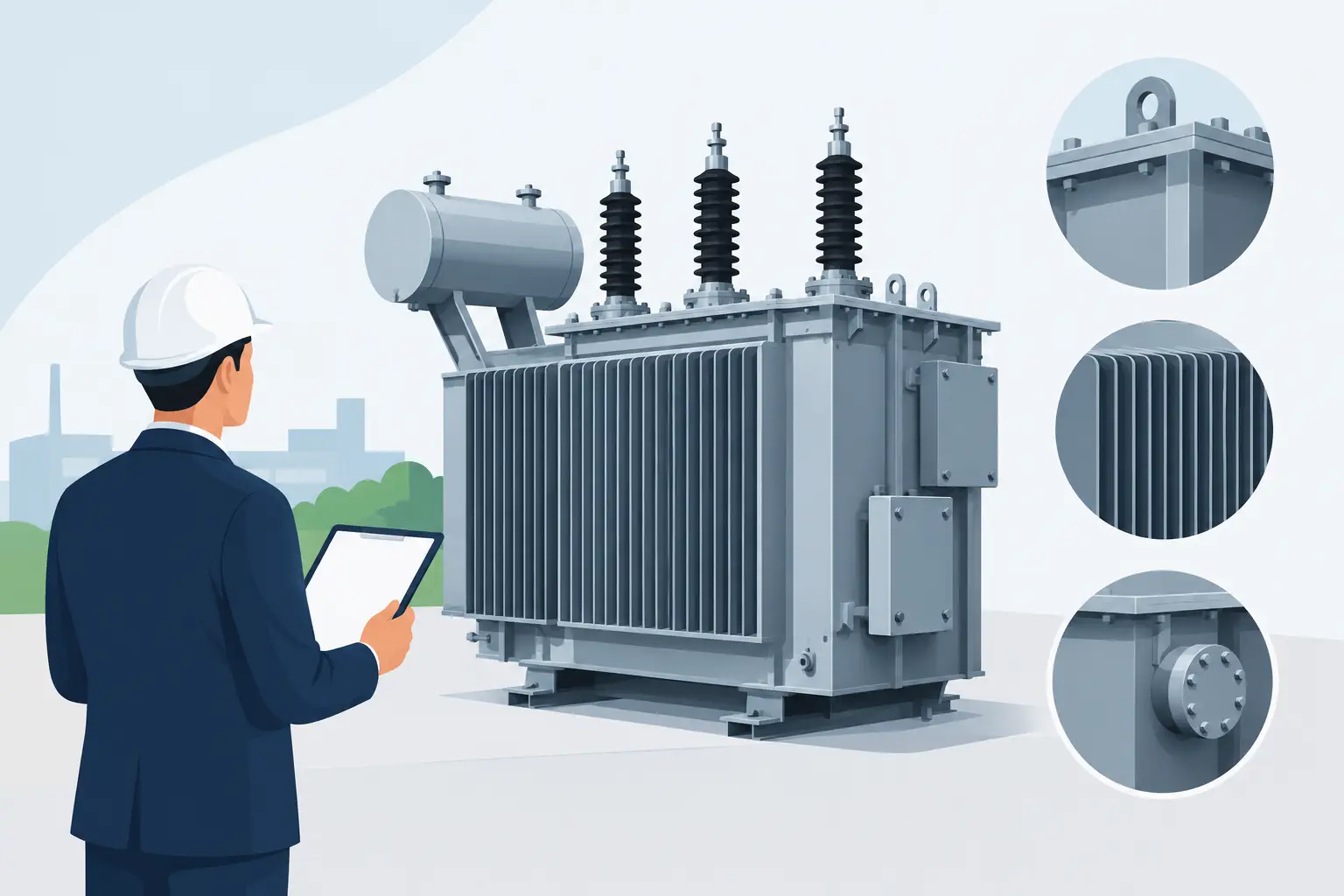
A transformer tank is not simply a welded steel enclosure. It is a pressure-sensitive, oil-containing assembly whose fit-up, weld sequence, lifting features, sealing surfaces, coating system, and inspection plan can affect both factory acceptance and field installation. This OEM guide to transformer tanks focuses on the manufacturing decisions purchasing teams and engineers should settle before releasing a fabrication package.
For OEMs, the sourcing question is rarely limited to whether a fabricator can cut and weld plate. The more useful question is whether the supplier can repeatedly manufacture the required tank geometry, manage weld quality, hold critical interfaces, document the agreed production records, and scale from prototypes to scheduled production without changing the process controls that matter.
Start with the transformer tank design package
A complete drawing package reduces avoidable engineering questions after steel has been ordered or parts have entered production. Tank drawings should clearly distinguish functional dimensions from reference dimensions, identify datums for inspection, and define requirements for interfaces such as radiators, bushings, manways, valves, grounding pads, lifting lugs, and mounting rails.
Material callouts deserve the same attention. Plate grade, thickness, formed-component requirements, structural shapes, pipe or flange specifications, and any approved substitutions should be explicit. Where corrosion performance is important, the coating specification should identify surface preparation, coating type, dry-film thickness requirements, cure requirements, color, and test methods. A fabricator should not infer these details from a general note when they affect the process plan.
For larger assemblies, include shipping dimensions, target component weight, lifting instructions, and restrictions on handling or stacking. These inputs help determine whether the tank can move through fabrication, coating, inspection, and outbound logistics in the intended orientation.
Define drawing-specific feasibility early
Machine capacity is useful context, but it is not a substitute for a drawing review. A 2,400-ton CNC press brake with a 53-foot forming length can support long formed components, while a 30 kW fiber laser with a 16-meter cutting bed can process large plate layouts. Whether a specific tank sidewall, cover, flange arrangement, or stiffener detail is feasible depends on material, thickness, bend geometry, part length, tooling, weight, handling, and required tolerances.
This distinction matters during supplier qualification. Ask the fabricator to review the actual released drawing, revision level, bill of materials, annual volume, lot size, and delivery schedule. A practical review identifies parts that need segmented forming, alternate weld access, machining after welding, dedicated fixtures, or a different sequence to control distortion.
Forming and fit-up determine more than appearance
Transformer tanks often combine flat plate with formed walls, covers, channels, reinforcement members, and attachment features. The quality of those early operations influences weld access and final dimensional condition. A part that is cut accurately but formed inconsistently can create gap variation, excessive weld buildup, difficult sealing interfaces, or a cover that requires force to fit.
Fabrication planning should establish how major panels will be nested, cut, formed, staged, and joined. It should also account for weld shrinkage. Long seams and heavily reinforced areas can pull a tank out of square or affect flange flatness. The right approach varies by design: some assemblies benefit from fixtures and controlled weld sequences, while others require intermediate checks and staged assembly to prevent accumulated variation.
Purchasing teams should ask which dimensions are inspected before welding and which are verified after welding. That conversation clarifies whether the supplier understands the difference between component-level conformance and completed-assembly conformance.
Welding quality is a production-control issue
Tank welding requirements may include structural welds, oil-tight seams, attachment welds, and welds near critical mounting or sealing features. The welding process must match the drawing, material, joint configuration, access, and applicable customer requirements. Visual acceptance criteria, nondestructive examination requirements, pressure or leak test requirements, and repair procedures should be stated in the quality plan rather than resolved informally on the shop floor.
An in-house AWS Certified Welding Inspector can support weld procedure oversight, visual inspection, and quality documentation within the agreed inspection plan. That role does not mean every weld receives independent third-party certification, nor does it remove the need for customer-defined acceptance criteria. It means the supplier has internal inspection capability that can be applied to the program requirements.
With more than 150 welding stations, IONSA can plan work across multiple operations rather than depending on a single station for every step. Actual capacity for a tank program still depends on assembly size, weld content, fixturing, inspection hold points, labor routing, and the mix of other production work. Buyers should ask for a process plan that connects those factors to the requested production schedule.
Inspection should follow the tank’s functional risks
Not every dimension has equal impact on transformer assembly. Critical characteristics commonly include overall length, width, and height; mounting interfaces; cover or gasket surfaces; nozzle locations; bushing and valve openings; radiator connection points; lifting features; and diagonal measurements that indicate squareness. The drawing and inspection plan should identify which of these require recorded results and which can be verified by standard in-process controls.
Creaform dimensional inspection equipment can support dimensional inspection under an agreed plan, particularly where large fabricated geometry must be compared against specified features. The appropriate measurement method, reporting format, datum strategy, and acceptance criteria should be established before production. Do not assume a scanning method alone defines the inspection requirement.
Leak testing is equally program-specific. The required medium, pressure, duration, permitted pressure decay, observation method, and documentation requirements should come from the customer specification or applicable standard. If the tank includes complex weldments, penetrations, or machined interfaces, define the test sequence so corrective work does not compromise completed coating or final assembly steps.
Coatings and enclosure requirements need precise language
Coating failures often originate before paint is applied. Weld spatter, sharp edges, surface contamination, inaccessible areas, and incomplete drainage can all affect preparation and coverage. Good design-for-manufacture review considers coating access, venting, drainage, masking, and whether separate components should be coated before final assembly.
Some pad-mounted transformer applications may include customer-specified coating requirements related to IEEE C57.12.28 enclosure integrity. That standard should not be treated as a blanket certification claim for every tank. The OEM should define the applicable enclosure, corrosion, coating, test, and documentation requirements for the specific equipment design.
Ask suppliers how they will preserve coating quality through material handling, final assembly, and shipment. Touch-up requirements, protected sealing areas, hardware installation sequence, and packaging expectations should be documented. A tank can pass final dimensional inspection yet still create downstream rework if its finish is damaged before it reaches the OEM’s assembly line.
Evaluate the supplier’s production records and quality system
A supplier qualification review should look beyond a single prototype. Repeatability comes from controlled routings, revision management, inspection records, material identification, nonconformance handling, and documented change control. MIETrak ERP can support production records, although the depth of traceability must be defined for each program.
AAR M-1003 certification is relevant evidence of a quality assurance system within its defined facility and activity scope. It should be reviewed in relation to the work being sourced, not used as a broad substitute for the OEM’s own technical and quality requirements. For transformer tanks, the practical question is whether the supplier’s controls align with the drawing, inspection plan, and documentation package required for the program.
For OEMs serving the United States and Mexico, fabrication in Monclova, Coahuila can also support regional supply strategies. Still, location should be evaluated alongside total landed cost, border planning, packaging, freight constraints, and communication cadence. A low piece price offers little value if dimensional issues, incomplete records, or shipping damage disrupt final assembly.
What to provide when requesting a quote
A quote request is more useful when it allows manufacturing engineering to assess the full job rather than price steel weight alone. Provide current drawings and revision history, material specifications, annual and release quantities, overall dimensions, component weight, requested schedule, coating requirements, weld and inspection requirements, and any test or documentation expectations. Include prototype, preproduction, and production milestones if they differ.
Request a quote from IONSA with those inputs so the team can conduct an engineering-informed review of forming, laser cutting, welding, inspection, and production routing. The goal is not just to establish a unit price. It is to identify the controls needed for tanks that arrive ready for the next stage of OEM assembly.