A truck frame rail example is most useful when it shows more than a long formed steel member. For an OEM sourcing team, the rail is a manufacturing package: controlled material, a defined cross-section, holes and interfaces in the correct locations, weld-ready features, inspection requirements, and records that support the production program. A supplier can have large equipment, but the rail must still be feasible against the released drawing and the program’s quality plan.
Heavy truck frame rails are often treated as straightforward fabrication because their basic form is familiar. In practice, long part length amplifies small variation. Hole location, flange condition, twist, camber, end features, crossmember interfaces, and weld sequence can all affect assembly fit. The right sourcing discussion starts with the engineering intent of the rail rather than a generic description of fabrication capacity.
Truck frame rail example: what the drawing should define
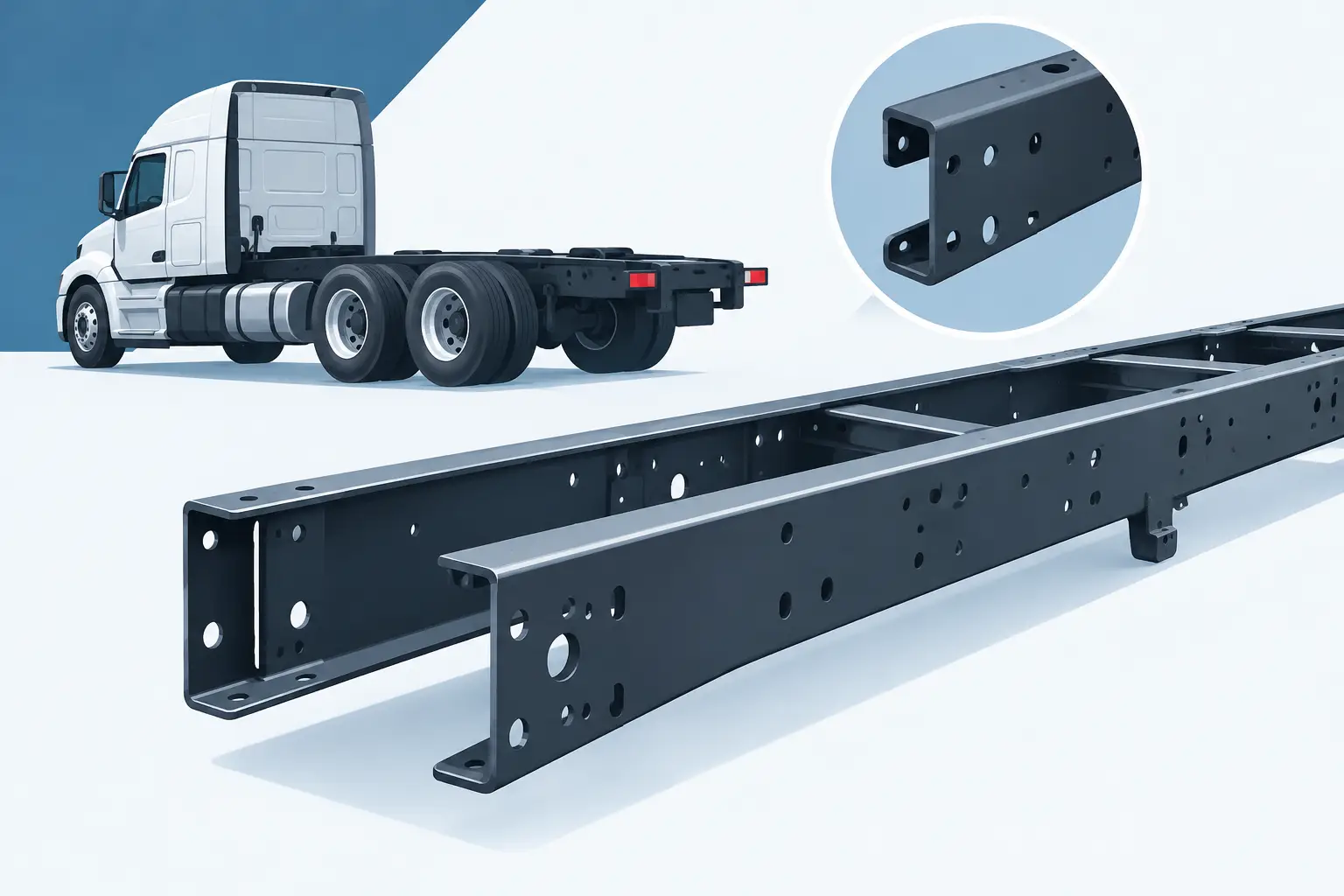
Consider a generic heavy truck chassis rail supplied as a long C-channel or formed section with mounting holes, end cutouts, reinforcement interfaces, and welded brackets. The customer drawing should identify the material grade and condition, nominal section geometry, overall length, hole patterns, datum scheme, permitted geometric variation, coating or corrosion-protection requirements, and any required marking or traceability information.
That information determines the manufacturing route. A rail may begin as laser-cut plate or supplied strip, then move through forming, secondary cutting or machining where required, fit-up, welding of brackets or reinforcements, inspection, and packing. Not every rail needs every process. A formed rail with no welded attachments has different risks than a rail delivered as a heavy subassembly with crossmember connections, gussets, suspension features, and multiple critical interfaces.
The drawing should also distinguish functional dimensions from reference dimensions. For example, the location of a mounting hole relative to an assembly datum may be more important than its location relative to the raw end of the rail. Establishing this early helps the supplier design fixtures and inspection points around what the vehicle assembly actually needs.
Long-part capacity must be matched to drawing feasibility
Equipment ratings are meaningful only when they are evaluated against a specific part. IONSA operates a 2,400-ton CNC press brake with a 53-foot forming length and a 30 kW fiber laser with a 16-meter cutting bed. Those capabilities are relevant to long chassis rails and heavy truck subassemblies because they support processing of large workpieces without automatically requiring the part to be divided into shorter sections.
However, a 53-foot press brake rating does not establish that every rail can be formed at full length. Material grade, thickness, bend radius, tooling geometry, flange depth, bend sequence, part handling, and allowable springback must be reviewed against the customer drawing. The same applies to the laser bed. A 16-meter cutting bed supports large plate layouts, but nesting, material condition, feature geometry, required edge condition, and downstream forming all influence the final process plan.
For buyers, this distinction matters. Asking whether a supplier has the right machine is a useful first screen. Asking how the machine, tooling, handling method, and inspection plan apply to the released rail is the more meaningful qualification question.
Section geometry affects more than forming
A truck rail section is selected for structural performance, but its geometry also affects production repeatability. Deep channels and closely spaced bends can limit access for tools and inspection. Narrow flanges may complicate fixture contact. Local features near bends may need to be cut before forming, after forming, or through a controlled combination of operations.
Hole and slot placement requires similar attention. Features close to a bend line can distort during forming, while features used to locate a subassembly need a datum strategy that survives multiple operations. An engineering-informed review should identify where part movement, springback, or welding heat could influence a feature that matters at final assembly.
Welding turns a rail into a subassembly
A basic frame rail can become a heavy subassembly quickly when brackets, gussets, reinforcement plates, suspension interfaces, or crossmember connections are added. Welding then becomes a central quality and dimensional-control issue, not simply a joining operation.
The weld sequence should consider access, restraint, heat input, part orientation, and the order in which features are attached. A sequence that is efficient at the welding station may create unwanted movement at a critical interface. Conversely, excessive restraint can create its own risks. The appropriate approach depends on the material, geometry, weld details, and the dimensional requirements specified by the customer.
IONSA has more than 150 welding stations and an in-house AWS Certified Welding Inspector. The AWS CWI supports welding inspection activities within the facility; it should not be interpreted as independent third-party certification of every weld. For an OEM program, the practical discussion is which weld requirements apply, what inspection is required, what acceptance criteria govern, and how records will be maintained for that program.
Inspection should follow the assembly function
Frame rail inspection is not limited to checking overall length. A practical plan may evaluate section shape, hole locations, interface positions, bracket orientation, weld condition, and the rail’s relationship to defined datums. The inspection method should be agreed before production, particularly for large assemblies where measurement access and fixture strategy influence the results.
Creaform dimensional inspection equipment can support dimensional inspection under an agreed plan. It can be useful for comparing formed and welded geometry to drawing requirements, checking complex interfaces, and reviewing first articles or production samples. The required inspection method, reporting format, and acceptance criteria remain customer- and program-specific.
For recurring production, the most effective inspection plan is usually targeted. It concentrates measurement effort on dimensions that influence downstream fit, vehicle alignment, or attachment of safety-relevant components. Collecting many nonfunctional dimensions without a clear acceptance purpose can add time without improving the decision-making value of the report.
Production records and traceability need clear boundaries
Purchasing and quality teams frequently require material documentation, lot control, weld records, inspection reports, serialized marking, or shipment-level documentation. These requirements should be stated in the request for quote instead of assumed. Traceability depth depends on the program, material source requirements, marking method, and the records specified by the customer.
MIETrak ERP supports production records at IONSA. The appropriate record set should be defined during program planning, including the part number and revision, approved material requirements, routing, inspection checkpoints, nonconformance handling, and document retention expectations. A production record is useful only when it corresponds to the agreed scope and can be retrieved when a buyer or quality team needs it.
Where a rail program includes special coating requirements, the specification should identify the required preparation, coating system, test criteria, and documentation. Some truck, utility, or enclosure programs may reference standards related to enclosure integrity. Requirements such as IEEE C57.12.28 should be applied only where specified by the customer and should not be treated as blanket certification for fabricated components.
What to send with a heavy truck rail RFQ
A complete RFQ allows the supplier to assess feasibility before pricing becomes disconnected from the actual scope. Provide the current drawing revision and any 3D model, material requirements, annual or release quantities, overall dimensions, component weight, requested production schedule, and delivery location. Include weld symbols, inspection requirements, documentation needs, coating requirements, packaging expectations, and whether the part is a single rail or a completed heavy subassembly.
It also helps to identify the parts that mate to the rail. Crossmembers, brackets, reinforcements, and customer-supplied components can change fixture design and weld access. If the program has a first-article requirement, pilot build, phased releases, or engineering changes expected during launch, include that information early.
For OEMs sourcing in the United States or Mexico, manufacturing in Monclova, Coahuila can support cross-border supply discussions, but logistics should be evaluated as part of the total program. Packaging, load configuration, border documentation responsibilities, delivery cadence, and the handling needs of long fabricated parts should be defined alongside manufacturing requirements.
A well-prepared truck frame rail RFQ gives engineering, quality, and purchasing teams the same starting point. Submit drawings, material, quantity, dimensions, weight, schedule, and inspection requirements for a manufacturing review and quote request. The goal is not merely to source a rail that can be made, but to establish a controlled process for rails and heavy subassemblies that must fit, perform, and repeat across production releases.